

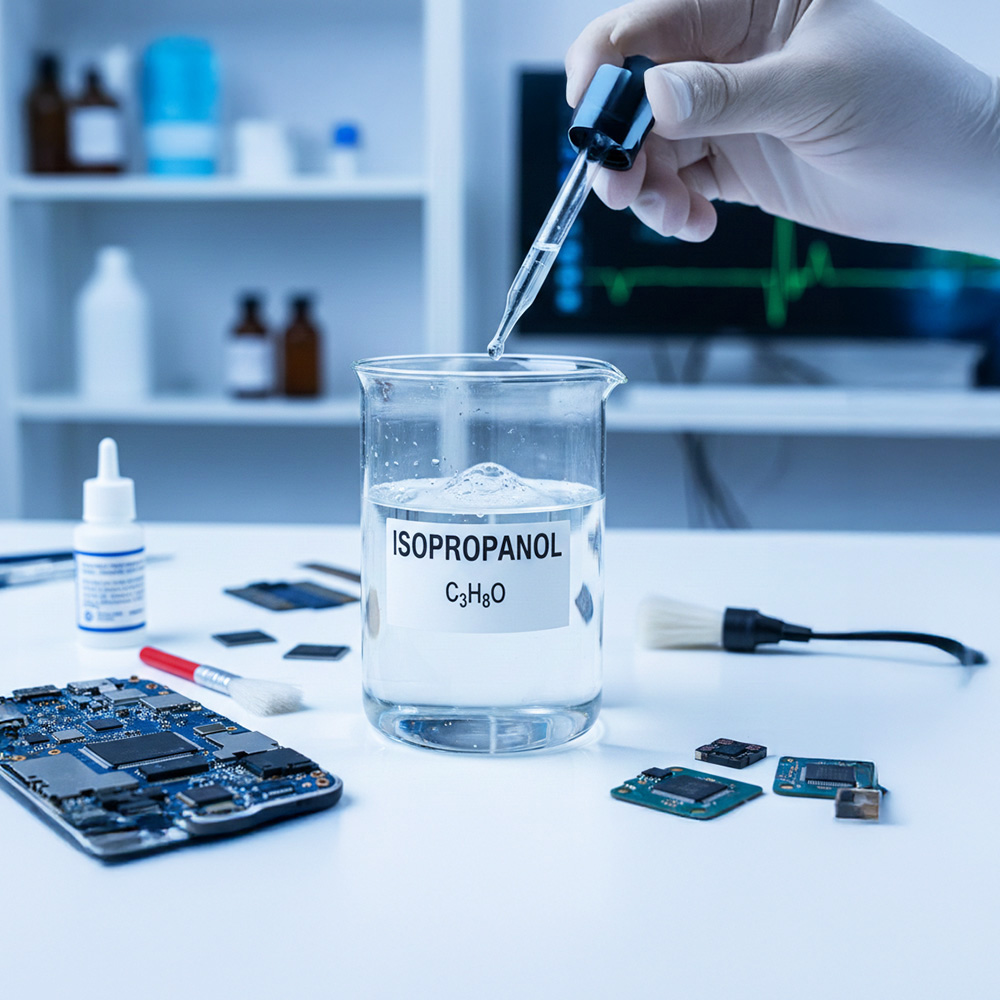
Isopropanol — The Quiet Hero of Everyday Life. From Electronics to the Pandemic: Why IPA Has Become Essential in the Modern World
Just a few years ago, isopropanol (IPA) was associated mainly with laboratories, electronic servicing, and industrial environments. It was a tool for professionals — technicians, engineers, and automation specialists. However, the COVID-19 pandemic turned this unassuming alcohol into one of the most widely recognised chemical substances in the world — finding its way into homes, offices, shops, workshops, and medical facilities.
Today, it is hard to imagine modern technology, servicing, and hygiene without isopropanol. Its versatility makes it at once a cleaning agent, degreaser, disinfectant component, and a trusted ally in precision applications.
Why is isopropanol so universal?The secret of IPA lies in its chemical properties:
- it evaporates quickly and leaves no streaks,
- it is chemically neutral to most materials,
- it does not conduct electricity,
- it effectively dissolves grease, contaminants, and residues,
- it is safe when used correctly.
Thanks to these qualities, it can be used wherever other agents fail or create a risk of damage.
Electronics and technology — where precision mattersIn the world of electronics, isopropanol is an absolute standard. It is used for:
- cleaning PCBs and assembly components,
- degreasing surfaces before soldering,
- maintaining connectors, sockets, and switches,
- removing flux residues,
- cleaning AV mechanisms and sensors.
Technicians choose IPA because it cleans thoroughly without causing damage — and without the risk of corrosion or electrical conductivity.
Workshops, industry, and servicing — one product, many applicationsIsopropanol is also widely used:
- in precision mechanics and automation,
- when preparing surfaces for bonding or painting,
- for cleaning tools and assembly parts,
- in printing facilities and production plants,
- in optics and measuring instruments.
In many companies, it has become a “first-choice solution,” combining effectiveness with safety.
The COVID-19 pandemic — the moment IPA moved from laboratories into everyday lifeUntil 2020, isopropanol was, for most people, something “technical.” The pandemic changed that completely.
IPA became the base for:
- hand disinfectants,
- surface cleaning solutions,
- hygiene measures in offices, shops, and workplaces.
At that time, the world was reminded of the crucial role that applied chemistry plays — not only in industry, but also in health protection and safety.
Household applications — where effectiveness matters without compromiseIsopropanol is increasingly used at home as well, for example for:
- cleaning screens and smartphones,
- degreasing bicycle parts or sports equipment,
- removing glue, marker traces, and dirt,
- maintaining DIY electronic equipment.
It is a product that — when used responsibly — can replace several different cleaners.
Safety and good practicesAlthough IPA is safe in technical applications, a few rules should always be followed:
- use it in well-ventilated areas,
- keep it away from open flames — it is highly flammable,
- avoid contact with eyes and skin,
- store it in a tightly sealed container.
Responsible use = maximum efficiency and full safety.
Isopropanol — a substance that connects the worlds of technology and everyday lifeThe story of IPA shows that a seemingly simple chemical compound can play a major role:
- in industry and electronics,
- in servicing and production,
- in hygiene and safety,
- in everyday life.
It is an example of chemistry that rarely draws attention — yet without it, the modern world would look completely different.