

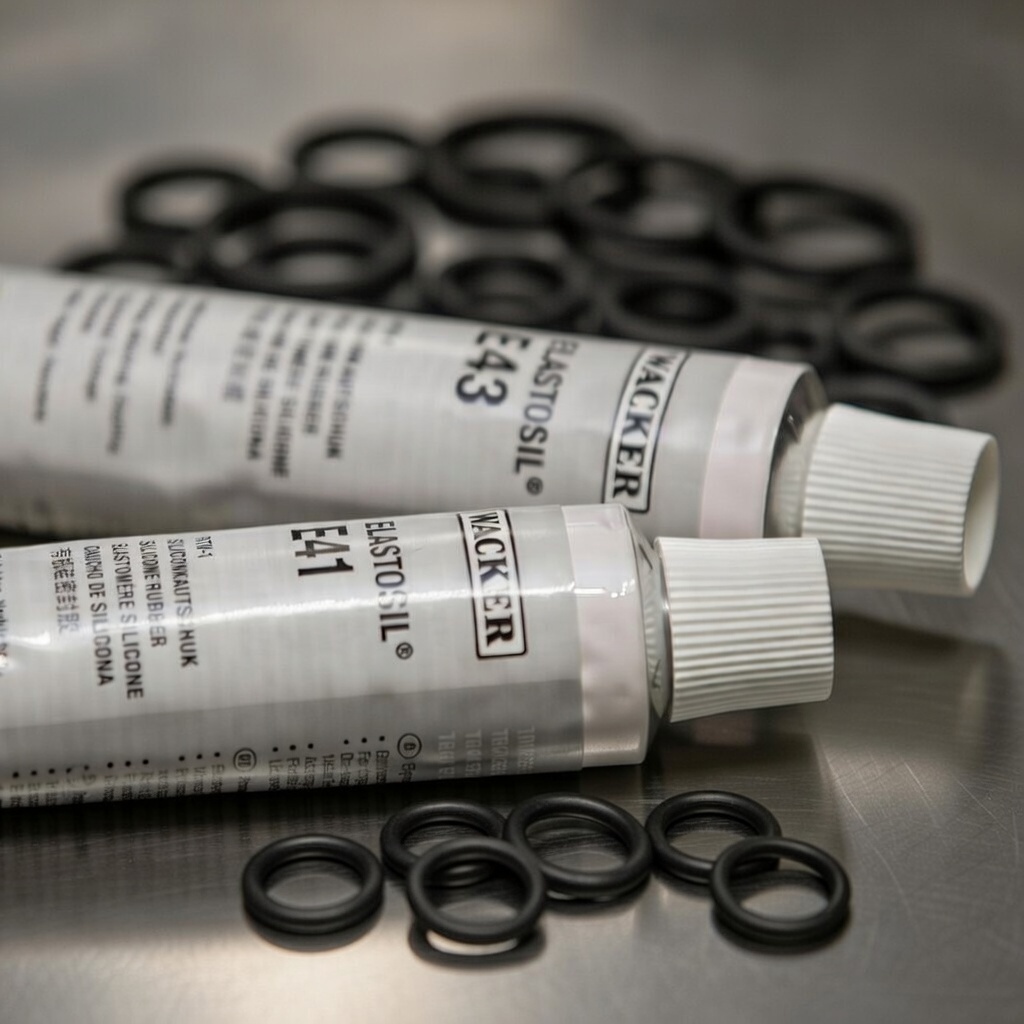
Three transparent silicones, three different characters
On the shelf they look almost identical: transparent, one-component, cured by atmospheric moisture, with the same characteristic smell of vinegar during use. ELASTOSIL® E41, ELASTOSIL® E43 and ELASTOSIL® E43 N belong to one family of RTV-1 silicones, so it is easy to treat them as interchangeable. Anyone who has ever applied a thin silicone to a vertical wall, or tried to impregnate a narrow gap with a thicker paste, knows that in practice success is decided in the first minutes after the material leaves the cartridge. And this is precisely where these three products diverge the most.
The simplest way to put it is this: E41 is the silicone that flows, E43 is the silicone that lays down, and E43 N is a refined version of E43 that holds its shape, is stronger and has food-contact approvals. Behind each of those short names are specific numbers and specific consequences at the assembly bench.
ELASTOSIL® E41 – when the material has to find its own way
E41 TF has a viscosity of about 65,000 mPa·s, several times lower than its siblings. It also contains about 17% of a synthetic isoparaffinic solvent, which further thins the mass and helps it wet the substrate. The effect is immediate: E41 spreads and self-levels, penetrates fine gaps, evens out irregularities and leaves a smooth, transparent surface. It is a material for coating, potting shallow recesses, sealing joints from above and wherever the look of a thin, even layer matters, for example in lighting fixtures.
It also has a property that is particularly valued in service work: it bonds exceptionally well to already cured silicone. A typical RTV-1 applied to old silicone rubber can simply peel away, whereas E41 was designed precisely for such joints. That is why it is a good choice for repairing and making up silicone gaskets, joining silicone parts, and sealing connections in household appliances, heating and cooling systems, lighting, mechanical engineering, railway and e-mobility. After cure it has a hardness of 40 Shore A, a tensile strength of 6.0 N/mm² and an elongation at break of 350%. It is therefore the hardest of the three, while remaining clearly flexible and tear-resistant.
The solvent, however, has a price, and it is worth keeping that in mind. As it evaporates it reduces the volume of the material, so E41 works best in thinner layers and as a coating, not as a compound for filling wide gaps. For the same reason it should not be accelerated with heat: hot curing only makes sense in a thin layer below 0.5 mm and at a temperature no higher than 80 °C, because acetic acid and solvent released quickly form bubbles. At room conditions (23 °C, 50% humidity) a skin forms after about 10–20 minutes, and the material cures in depth at a rate of about 3 mm per day. When working with E41, good ventilation is also essential.
ELASTOSIL® E43 – a universal adhesive and sealant without solvent
E43 is a completely different consistency. At low shear rates its viscosity reaches 250,000 mPa·s, and during extrusion it falls to about 175,000 mPa·s. Such a material does not run away from the point of application the way E41 does, but it still levels moderately: the bead smooths slightly and wets the substrate well, instead of remaining a sharp “caterpillar”. That is a very convenient property when bonding flat parts and making form-in-place gaskets (FIPG), where the mass should sit evenly but not flow beyond the edge.
The most important process difference, however, is that E43 contains no solvent. What you apply stays, with no shrinkage from evaporation. That is why E43 is better suited to thicker joints, bonding and sealing in industrial assembly, in household appliances, automotive, aerospace and railway applications, and also in electronics, where it serves as a multipurpose FIPG sealant. Like E41 it has very good adhesion to cured silicone rubber, and it also works on silicone-coated fabrics, for example when sealing seams. Without a primer it also bonds well to glass, ceramics, metals, many plastics and powder coatings.
After cure, E43 is softer than E41 (30 Shore A), but clearly more extensible. Its elongation at break is 500%, and its tensile strength is 6.5 N/mm². In practice this means a joint that better withstands movement of parts with different thermal expansion, vibration and temperature cycling. A skin forms after about 10 minutes, and through-cure takes about 12 hours per millimetre. During vulcanisation about 4% by mass of acetic acid is released.
ELASTOSIL® E43 N – what the letter “N” adds
E43 N is easy to treat as a minor modification of E43, but the differences matter. First of all it is thixotropic: depending on how it is applied, it behaves anywhere from a non-slump paste to a self-levelling compound. At rest it has a viscosity of about 250,000 mPa·s, and during extrusion it thins to about 150,000 mPa·s, more than E43 does. It is therefore easier to dispense, and after application it holds its shape better. If the joint is to be made on a vertical wall or overhead, E43 N is the natural choice in this family.
The second point is strength. At the same hardness of 30 Shore A, E43 N reaches 7.8 N/mm² tensile strength, 450% elongation and 12.5 N/mm tear strength. The service range starts at −50 °C and ends at +180 °C. It also skins over faster (5–10 minutes), but cures more slowly in depth, at about 1.6 mm per day. For thicker joints this should be allowed for in the production schedule.
The most important point, however, is the approvals. Fully cured E43 N meets the requirements of BfR Recommendation XV “Silicones” and of FDA 21 CFR §175.105, §175.300, §177.1210 and §177.2600, and, when properly processed, is suitable for producing food-contact materials within the meaning of Regulation (EC) No 1935/2004. That is why E43 N is the first choice for bonding and sealing in household appliances and machinery that come into contact with food. There is one condition: the part must be fully cured, acetic acid must no longer be evolving, and residual solvent must be removed from the finished article. Neither E41 nor E43 has such approvals, and they are not intended for food contact.
There is one more property that often only becomes apparent after a failed attempt: E43 N does not inhibit the cure of platinum-catalysed (addition-curing) silicones. Many RTV-1 compounds can poison a platinum catalyst, leaving an RTV-2 silicone poured nearby still tacky. If an RTV-1 adhesive and an addition-curing silicone meet in the same article, this property of E43 N genuinely saves nerves and material.
What to watch for with all three
All three cure with the release of acetic acid, so the same rules apply. The material needs free access to atmospheric moisture. In closed, sealed spaces curing will be very slow, and raised humidity speeds the process more clearly than temperature. Acetic acid vapours can promote corrosion of exposed copper, brass or zinc coatings, so with electronics that have bare tracks and with sensitive metals a trial is always worthwhile. The room must also be well ventilated. Unvulcanised material is easiest to remove with white spirit or another non-polar solvent, before it has time to cure. Later, only mechanical removal or a special silicone remover remains. After full cure, all three products withstand changing weather, UV radiation and long-term service at temperatures up to 180 °C without difficulty.
Which should you choose?
The choice starts with the question of what the material should do in the first minute after application. If it should spread, penetrate a gap, cover a part with a thin, smooth layer or bond to already cured silicone, reach for E41 (also available in a handy 90 ml tube). If you need a universal, solvent-free adhesive and sealant for assembly that smooths slightly and gives a highly extensible joint, choose E43. It is available in a 310 ml cartridge, a 90 ml tube and a 22 kg pack for production use. If the joint must hold its shape on a vertical surface, withstand higher loads, work at low temperatures, come into contact with food or sit next to a platinum-catalysed silicone, choose E43 N (also in a 90 ml tube).
Whatever you choose, we always recommend a short trial on the actual substrate and under real service conditions. Those few minutes most often decide whether the joint will last for years.
Property comparison
| Property | ELASTOSIL® E41 TF | ELASTOSIL® E43 | ELASTOSIL® E43 N |
|---|---|---|---|
| Type | RTV-1, acetoxy | RTV-1, acetoxy | RTV-1, acetoxy |
| Consistency | flowable, self-levelling | moderately self-levelling | thixotropic, from non-slump to self-levelling |
| Solvent | yes, approx. 17% | no | trace residues |
| Dynamic viscosity | 65,000 mPa·s (23 °C) | 250,000 / 175,000 mPa·s (25 °C; 0.5 / 25 1/s) | 250,000 / 150,000 mPa·s (25 °C; 0.5 / 25 1/s) |
| Density before cure | 1.048 g/cm³ | 1.09 g/cm³ | 1.09 g/cm³ |
| Skin-over time (23 °C, 50% r.h.) | approx. 10–20 min | 10 min | 5–10 min |
| Cure rate (23 °C, 50% r.h.) | 3 mm/day | 12 h/mm | 1.6 mm/day |
| Colour after cure | transparent | transparent | transparent |
| Shore A hardness | 40 | 30 | 30 |
| Tensile strength | 6.0 N/mm² | 6.5 N/mm² | 7.8 N/mm² |
| Elongation at break | 350% | 500% | 450% |
| Tear strength | high | high | 12.5 N/mm |
| Density after cure | 1.12 g/cm³ | 1.10 g/cm³ | 1.12 g/cm³ |
| Service temperature | −45 to +180 °C (briefly 200 °C) | −45 to +180 °C (briefly 200 °C) | −50 to +180 °C |
| Acetic acid release | yes | approx. 4 wt% | approx. 3.5 wt% |
| Electrical insulation | yes | — | yes |
| No inhibition of platinum silicones | — | — | yes |
| Food contact | no | no | yes (BfR XV, FDA 21 CFR) |
| Particular adhesion | cured silicone | cured silicone, silicone-coated fabrics | glass, ceramics, metals, plastics |
| Best suited to | coatings, potting shallow recesses, silicone repairs | bonding, FIPG, seams, assembly | vertical joints, FIPG, food contact |