

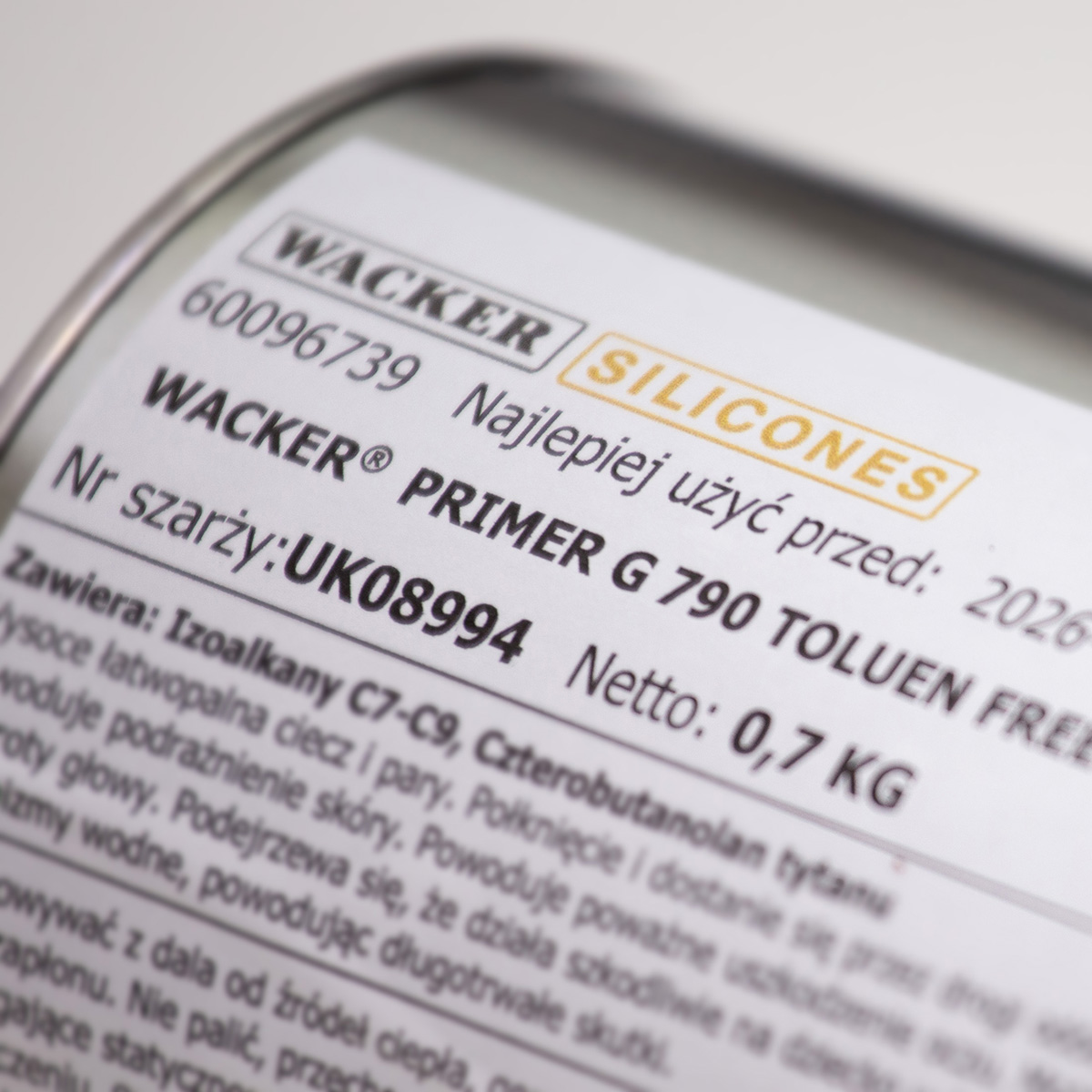
When working with addition-curing RTV-2 and LSR silicones, a common question arises: is a primer really necessary, or is it just a "just-in-case" safeguard? In practice, proper use of an adhesion primer determines how durable the bond will be – and skipping it can lead to costly complaints. Primer G 790 is not an optional extra to be used by guesswork, but a process tool that should be applied deliberately.
When should you use Primer G 790?
G 790 should be used wherever the silicone must bond permanently to the substrate and the joint has to withstand long-term service. This applies above all to potting applications, moulding of parts, insulation and technical seals, where detachment of the silicone from the substrate means loss of its protective function.
The primer is particularly recommended for:
- potting electronics and electrical components,
- moulding silicone parts directly onto metal or plastic,
- applications exposed to moisture, heat and vibration,
- series production, where repeatable adhesion is required,
- substrates that are difficult to bond (smooth metals, glass, ceramics, some plastics).
In such cases, G 790 forms an adhesion bridge that enables chemical and mechanical bonding of the silicone to the surface.
When is Primer G 790 not needed?
Not every application requires priming. If the silicone is intended as free-standing potting, cushioning or protection without the need for permanent bonding to the substrate, a primer may be unnecessary. This applies, for example, to applications where the silicone must remain removable or act as a flexible release layer.
A primer is also not necessary:
- for short-term laboratory tests,
- in temporary applications,
- when the silicone manufacturer explicitly permits application without a primer,
- where a lack of adhesion is functionally desirable.
So the key question is not "should I use a primer?", but what end result you want to achieve.
How to apply Primer G 790 correctly – step by step
1. Surface preparation
This is the most important stage of the whole process. Even the best primer will not work on a poorly prepared surface.
The substrate must be:
- dry,
- clean,
- free from grease, oils, dust and residues of release agents.
It is recommended to degrease the surface with isopropanol (IPA) or another suitable cleaning agent and leave it until it has fully evaporated. For metals, light abrading is acceptable if the process requires it.
2. Applying the primer
Primer G 790 is applied in a very thin coat – excess primer does not improve adhesion and may even impair it. The product can be applied:
- by brush,
- by dipping,
- by spraying (in series production).
The aim is a uniform, thin film without runs or pooling. After application, the surface should look slightly wetted, not flooded.
3. Flash-off and activation time
After applying the primer, wait until the solvent has evaporated completely. The typical time is:
- 30–60 minutes at room temperature.
During this time the primer forms an active adhesion layer. Do not speed up this stage with hot air, and do not apply silicone onto a "wet" primer.
4. Applying the silicone
Once the primer has flashed off, you can apply the RTV-2 or LSR silicone. The best results are achieved when the silicone is applied within a few hours of priming. Longer intervals may require the primer to be reapplied.
After the silicone has cured, you get a durable, environmentally resistant bond that significantly outperforms the adhesion achieved without a primer.
Summary
Primer G 790 is not a spare "extra", but a tool for controlling the quality and durability of the silicone-to-substrate bond. Used deliberately, it:
- increases reliability,
- eliminates the risk of delamination,
- stabilises the production process,
- lets you take full advantage of the properties of addition-curing silicones.
At SILRAY we often repeat one sentence: if adhesion matters, a primer is not an option – it is part of the process. If you are unsure whether G 790 is needed in your application, check before starting production, not after the first complaint.