

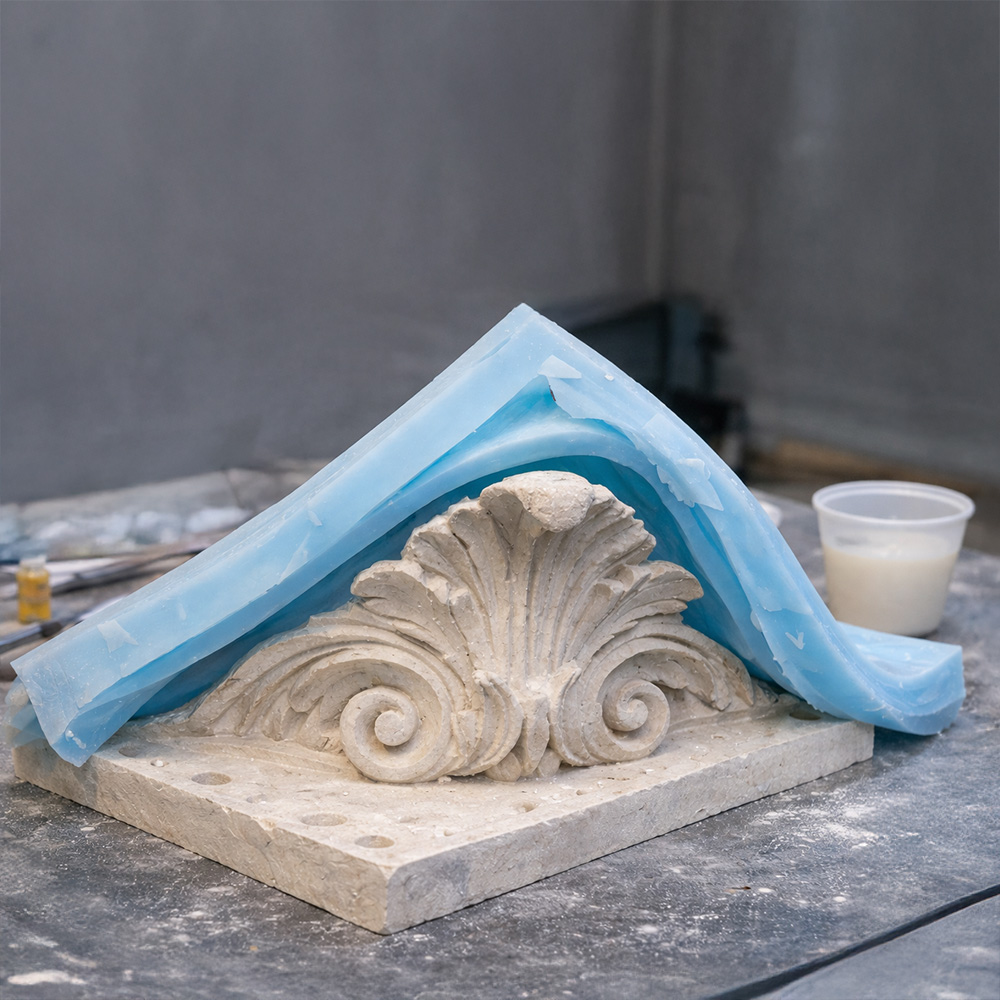
Just a few years ago, creating casting moulds was a costly, time-consuming process that required extensive experience. Hard tooling materials demanded machining, adjustments, and multiple test fits — and every mistake meant wasted time and resources. The breakthrough came with the widespread adoption of silicone mould-making materials, which combined highly precise detail reproduction with flexibility and ease of use. Today, it is difficult to imagine prototyping, artistic craftsmanship, or small-batch production without silicone moulds.
The greatest advantage of silicone is that, once cured, it becomes an elastic, resilient, yet dimensionally stable material. The mould can be gently deformed while removing the casting and then return to its original shape without the risk of cracking. This is especially important for components with complex geometries, sharp edges, or numerous undercuts, where traditional rigid moulds would be nearly impossible to use. In addition, silicone mould materials exhibit no shrinkage after curing, offer chemical resistance, and maintain thermal stability — which allows them to work with a wide variety of casting media, from plasters and waxes to polyurethane and epoxy resins, as well as architectural concrete and composites.
In practice, different types of silicone mould compounds are used depending on the application. For example, ELASTOSIL M series products are widely used for creating moulds for decorative castings, stucco elements, artistic models, and conservation work — wherever faithful reproduction of surface texture and fine detail is essential. Meanwhile, systems with higher mechanical resistance, such as harder grades of ELASTOSIL RT, perform well in working moulds for short production runs, where the mould must withstand greater loads and repeated casting cycles.
Choosing the right silicone always depends on the nature of the project. Softer, highly elastic materials work better for delicate sculptures and artistic models, whereas large architectural or technical components often require silicones with higher tear strength. For precise prototype castings, the viscosity of the mixture also plays an important role — more fluid systems, such as selected ELASTOSIL RTV-2 grades, allow better penetration of fine details and help reduce the risk of air bubbles.
Today, silicone mould materials are used across an exceptionally wide range of industries. They are employed by architectural studios, manufacturers of decorative and composite elements, creators of artisan goods, historic-restoration specialists, industrial-design teams, and R&D departments developing product prototypes. In all of these fields, a silicone mould enables a fast transition from concept to physical object — without the costs typically associated with rigid forming tools.
Importantly, silicone is no longer merely an “auxiliary material,” but a fully fledged design tool that actively shapes the creative process. It reduces costs, shortens implementation time, enables testing of geometric variations, and allows modifications without halting the entire production workflow. This is why mould-making products such as ELASTOSIL® M, ELASTOSIL® RTV-2, and selected silicone resins for technical moulds have become the standard for professionals who combine technology with creativity.
As a result, silicone moulds bring together manufacturing precision and creative flexibility — enabling faithful reproduction of detail, long-term durability, and consistent repeatability. This makes silicone moulding a foundation of modern craftsmanship, prototyping, and small-batch production — and at the same time, a technology that continues to open new design possibilities.