

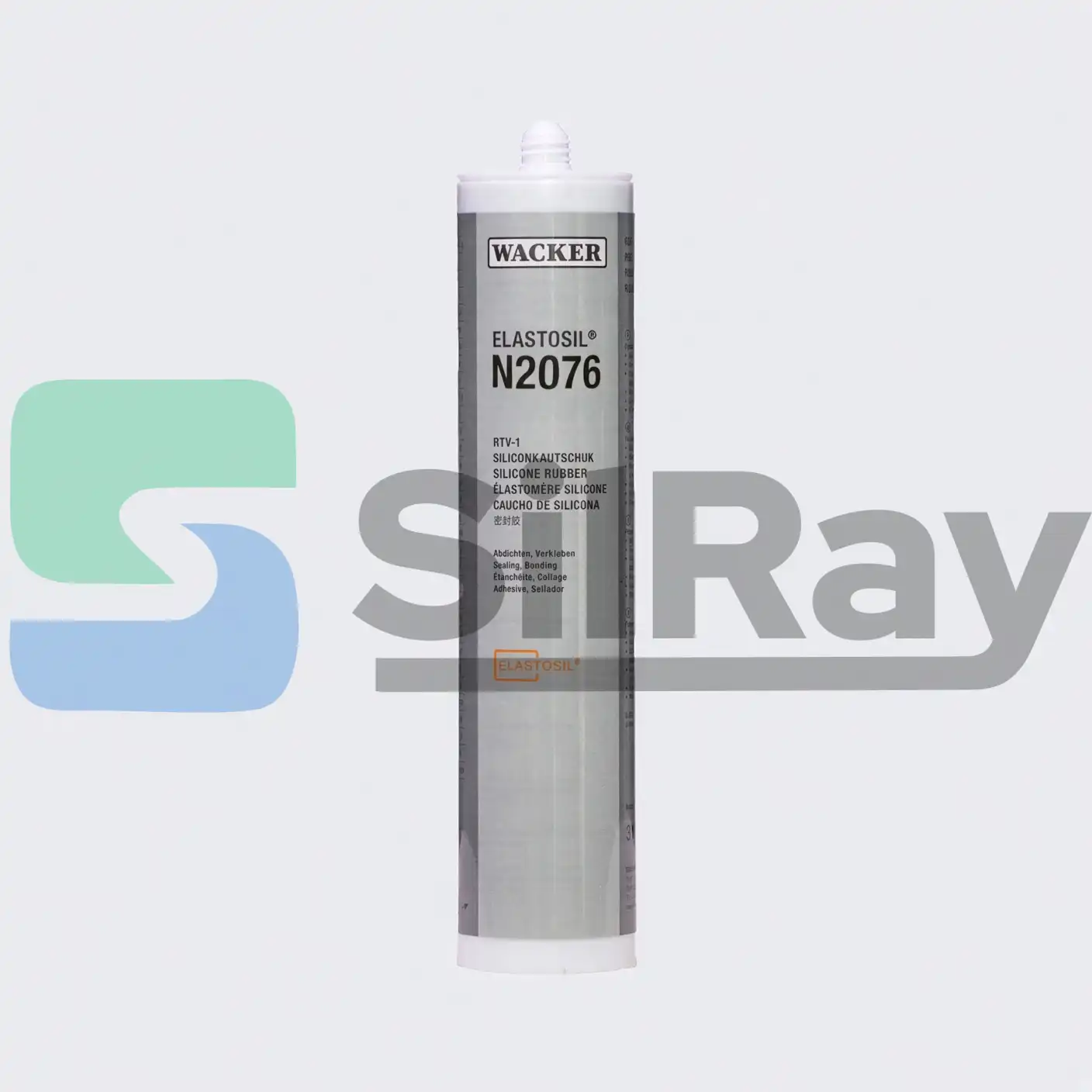


WACKER ELASTOSIL N2076 310ml – Anthracite Silicone for Coil Coating and Potting, EN 45545-2, Shore A 36
Packaging: 310ml
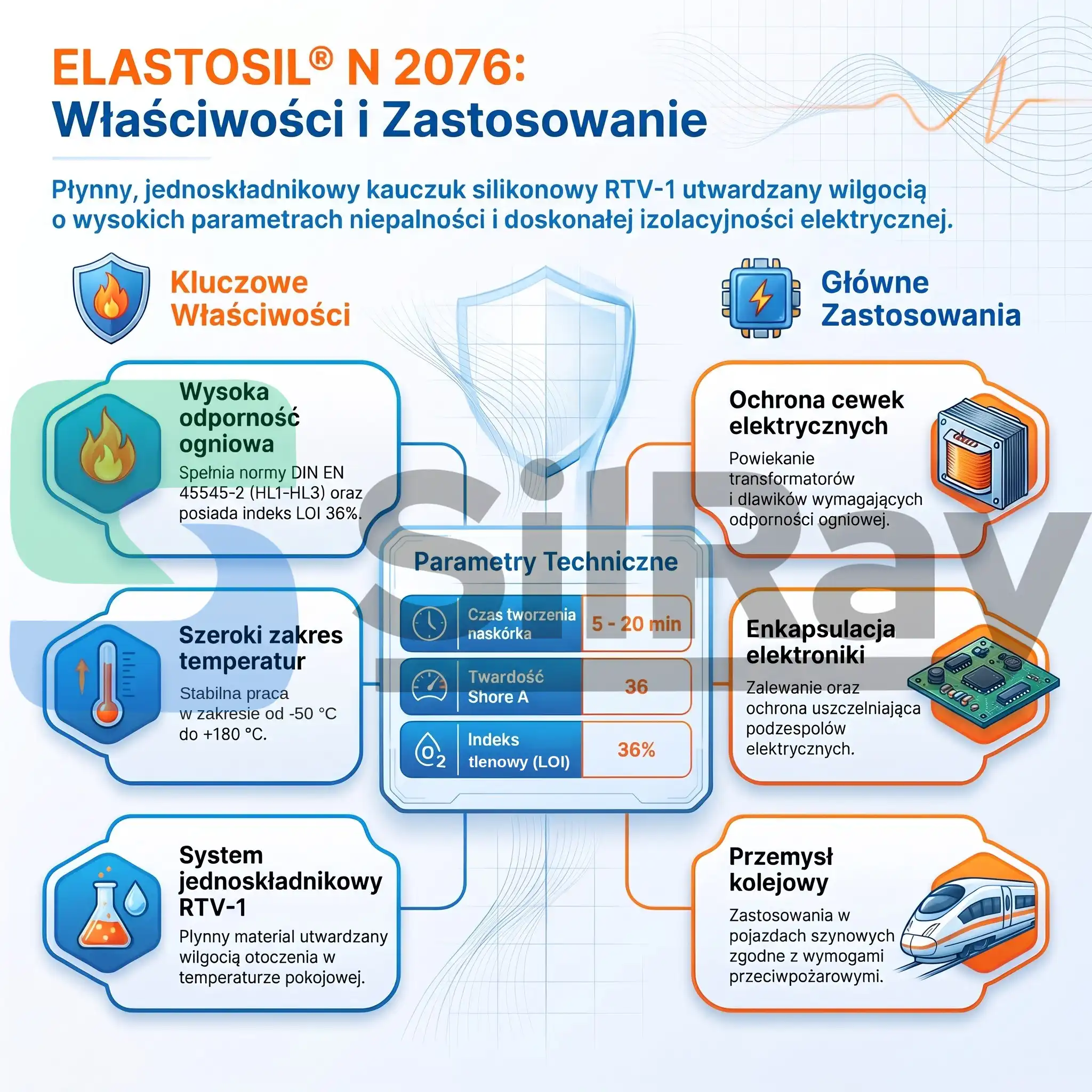
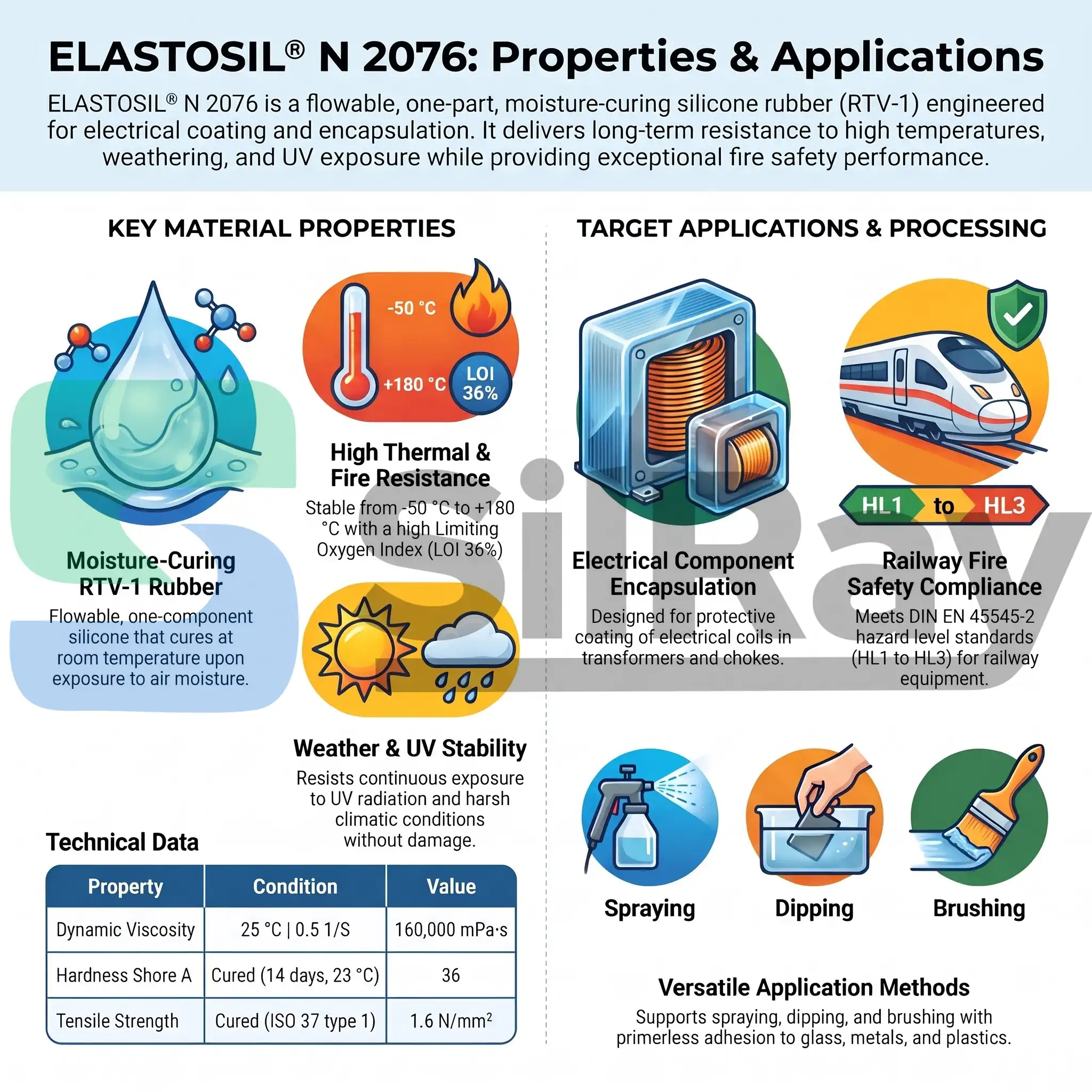
ELASTOSIL® N 2076 is a one-component, self-leveling RTV-1 silicone with a neutral (alkoxy) cure system, designed for coating electrical coils and potting electrical devices. It cures at room temperature on exposure to atmospheric moisture, forming a permanently flexible, anthracite coating with excellent flame-retardant properties. It meets the requirements of EN 45545-2 (R22: HL1 and HL2; R23 and R24: HL1, HL2 and HL3) and is intended for applications in the electrical industry and rail transport. Recommended service temperature range: –50 °C to +180 °C.
Ask about the product

Product code: N2076310ml 60120431
Specifications
RTV-1 Silicones
- Max. Service Temperature up to 180 °C
- Cure System neutral (alkoxy)
- Consistency self-leveling
- Color anthracite
- Hardness 36–50 ShA
- UL 94 V-0 no
- MIL-A-46146 no
- MIL-A-46106 no
- EN 45545-2 yes
- Food Contact no
- Electronics Potting yes
- Conformal Coating yes
- Sealing no
- Bonding no
Description
ELASTOSIL® N 2076 is a one-component, self-leveling RTV-1 silicone rubber designed for coating and potting. The material cures at room temperature on exposure to atmospheric moisture and forms a permanently flexible silicone elastomer with good heat resistance and excellent flame-retardant properties. Once fully cured, the coating offers long-term stability against weathering, moisture and UV radiation; it can be continuously exposed to changing climatic conditions, UV radiation and temperatures of up to 180 °C without damage.
The product is ready to use and requires no mixing. It crosslinks by condensation, and the by-product of curing is alcohol (a neutral, alkoxy system). Once cured, the silicone usually shows good primerless adhesion to many substrates, including glass, ceramics, metals, plastics, powder coatings and wood-based materials. The material is electrically insulating and resistant to weathering and UV.
Properties:
ELASTOSIL® N 2076 has a medium viscosity and a self-leveling (flowable) consistency, which makes it easy to coat surfaces evenly. After curing it reaches medium hardness and remains flexible across the recommended service temperature range of –50 °C to +180 °C.
The product stands out for its flame retardancy and a high limiting oxygen index (LOI) of 36%. The silicone meets the requirements of DIN EN 45545-2 for hazard levels HL1 and HL2 under requirement set R22 and for HL1, HL2 and HL3 under requirement sets R23 and R24 (tested to DIN EN 45545-2:2013+A1:2015; certificate available from the manufacturer on request).
The material is designed for the protective coating of electrical coils: it forms durable coatings with good heat resistance and excellent flame-retardant properties.
Applications:
According to the manufacturer, ELASTOSIL® N 2076 is intended for:
-
general-purpose coating, especially where fire resistance is required — including electrical coils of small transformers and chokes
-
potting (encapsulation) of electrical devices
-
applications in the electrical industry and in rail transport
Typical areas named by WACKER also include household appliances, electrical components for railways, heating and cooling, and machine building.
Processing:
ELASTOSIL® N 2076 is a ready-to-use, one-component material. Crosslinking starts on contact with atmospheric moisture, so free access of moisture to the silicone is essential. The vulcanization time can be reduced considerably by increasing the relative humidity of the air. Unlike the initial skin formation, the total curing rate of RTV-1 silicones is limited by the diffusion rate of moisture in the elastomer. Raising the temperature has only a minor effect on the skin formation time and the curing speed, so the product is typically cured at room temperature.
The material is self-leveling and can be used as supplied or — if necessary — as a solvent-based coating suspension. As suitable diluents the manufacturer names non-polar aliphatic solvents (e.g. technically dry cyclohexane, white spirit or similar) and non-polar aromatic solvents (e.g. technically dry toluene or xylene). The prepared mixture must be stirred continuously to prevent sedimentation of the fillers. Containers for storage and processing should be moisture-tight; if necessary, they can be filled and purged with dry nitrogen or argon.
The coating can be applied by common methods such as spraying, dipping and brushing. For substrates of simple geometry the manufacturer recommends airless spraying, which limits premature curing of the silicone. Parts with a more complex geometry (such as electrical coils) should preferably be coated by dipping. When the material is applied from a solvent-based suspension, the coated parts should be left in a well-ventilated place until the solvent has evaporated. The coating usually becomes tack-free within a few hours, while full curing takes several days at 23 °C and 50% relative humidity.
Technical data
| Property | Conditions | Value |
|---|---|---|
| Color | – | anthracite |
| Dynamic viscosity | 25 °C, 0.5 s⁻¹, ISO 3219 | 160,000 mPa·s |
| Dynamic viscosity | 25 °C, 25 s⁻¹, ISO 3219 | 18,500 mPa·s |
| Skin formation time | 23 °C / 50 % r.h. | 5–20 min |
| Curing speed | 23 °C / 50 % r.h. | 1.5 mm/d |
| Density | 23 °C, DIN EN ISO 2811-2 | 1.30 g/cm³ |
| Density after curing | 23 °C, in water, DIN EN ISO 1183-1 A | 1.3 g/cm³ |
| Shore A hardness | 14 d / 23 °C / 50 % r.h., 2 mm, DIN ISO 48-4 | 36 |
| Tensile strength | 14 d / 23 °C / 50 % r.h., 2 mm, ISO 37 type 1 | 1.6 N/mm² |
| Elongation at break | 14 d / 23 °C / 50 % r.h., 2 mm, ISO 37 type 1 | 150 % |
| Limiting oxygen index (LOI) | ISO 4589-2:2017 | 36 % |
| Recommended service temperature range | – | –50 °C to +180 °C |
The values given are indicative and should not be used as the basis for preparing specifications. Cured properties: 14 days at 23 °C and 50% relative humidity, 2 mm sheet, no post-curing.
Comparison of ELASTOSIL® silicones
The comparison below applies to the same chemistry in every pack size: N2076 310 ml and N2076 25 kg, N2010 310 ml, N2034 310 ml, RT 622 A/B 1 kg (also 5 kg and 30 kg) and RT 772 1.2 kg. Data that are not given are marked “–”.
| Property | N2076 | N2010 | N2034 | RT 622 A/B | RT 772 |
|---|---|---|---|---|---|
| System | RTV-1, condensation-curing (alkoxy) | RTV-1, alkoxy | RTV-1, alkoxy | RTV-2, addition-curing | RTV-2, condensation-curing |
| Composition / mixing | 1K, ready to use | 1K, ready to use | 1K, ready to use | 2K, 9:1 (A:B, by weight) | 2K, recommended 10:1 with Catalyst T 77 / T 77 PLUS |
| Color after curing | anthracite | colorless / translucent | black | reddish brown | black (base: cream) |
| Viscosity | 160,000 mPa·s (25 °C, 0.5 s⁻¹); 18,500 mPa·s (25 s⁻¹) | 15,000 mPa·s (0.5 s⁻¹); 10,000 mPa·s (25 s⁻¹) | 30,000 mPa·s (25 °C, 0.5 s⁻¹); 12,500 mPa·s (25 s⁻¹) | 12,000 mPa·s (A+B mix, 23 °C) | approx. 25,000 mPa·s (10:1 mix, 25 °C, 0.5 s⁻¹) |
| Skin formation / pot life | skin formation 5–20 min (23 °C / 50 % r.h.) | skin formation 20 min (23 °C / 50 % r.h.) | skin formation 20 min (23 °C / 59 % r.h.) | pot life 60 min (23 °C, up to 60,000 mPa·s) | pot life 10–15 min (T 77, 10:1, 23 °C); 5–8 min (T 77 PLUS, 10:1) |
| Curing | 1.5 mm/d (23 °C / 50 % r.h.) | – | – | 24 h at 23 °C | tack-free time approx. 90 min (T 77, 10:1, 23 °C) |
| Shore A hardness | 36 | 25 | 35 | 27 | 32 |
| Tensile strength | 1.6 N/mm² | 1 N/mm² | 2 N/mm² | 6.5 N/mm² | 2.0 N/mm² |
| Elongation at break | 150 % | 200 % | 200 % | 550 % | 130 % |
| Density after curing | 1.3 g/cm³ | 1.01 g/cm³ | 1.16 g/cm³ | 1.13 g/cm³ | 1.23 g/cm³ |
| Recommended service temperature range | −50 °C to +180 °C | −45 °C to +180 °C | −45 °C to +180 °C | – | −50 °C to +230 °C |
| Fire standards / LOI | EN 45545-2: R22 HL1–HL2, R23/R24 HL1–HL3; LOI 36 % | – | UL 94 V-0 | EN 45545-2:2020: R22 HL1, R23/R24 HL1–HL2 | UL 94 HB (with Catalyst T 77) |
| Typical applications | coil coating, potting of electrical devices, railways | general-purpose potting and coating | sealing and bonding, FIPG (e.g. automotive lamps) | potting of electronics and windings, railways | potting, coating and sealing; household appliances, automotive, machinery |
For N2010 and N2034 the recommended range is −45…+180 °C; flexibility from −50 °C is also stated for these products. No operating temperature range is given for RT 622. “–” means the value is not given.
How to choose: N2076 when the EN 45545-2 railway standard is required for coil coating; N2010 as a colorless, general-purpose RTV-1; N2034 when UL 94 V-0 is required; RT 622 for deep potting of windings with EN 45545-2; RT 772 when service up to +230 °C is needed.
Guides
- Acetoxy, Amine or Neutral Silicone for Electronics? – how to choose an acetoxy, amine or neutral silicone for electronics.
- WACKER ELASTOSIL® – a benchmark of quality in electronics and industry – why ELASTOSIL has become a quality standard in industry.
Files to download
 Elastosil-N2076-310ml-TDS-en.pdf
52.78 kB
Technical Data Sheet (TDS) – WACKER ELASTOSIL N2076 310ml – Anthracite Silicone for Coil Coating and Potting, EN 45545-2, Shore A 36
Elastosil-N2076-310ml-PCS-en.pdf
84.26 kB
Regulatory Product Information (PCS) – WACKER ELASTOSIL N2076 310ml – Anthracite Silicone for Coil Coating and Potting, EN 45545-2, Shore A 36
WACKER-broszura-7461C-EN-n2076-310ml-en.pdf
871.26 kB
Brochure – WACKER Industrial Coating or Sealing Applications (7461C)
WACKER-broszura-1099-EN-n2076-310ml-en.pdf
772.51 kB
Brochure – WACKER Silicones for Railway Applications (1099)
Recommended products
-
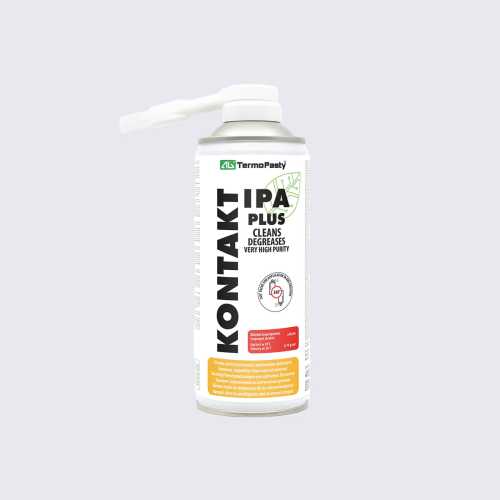
KONTAKT IPA PLUS 400ml – Isopropyl Alcohol (IPA) Cleaner and Degreaser for Surfaces and Electronics
Price €9.49Price €7.72 -
Bestseller
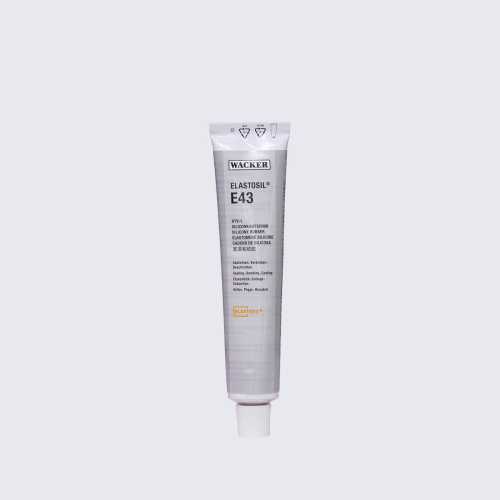
WACKER ELASTOSIL E43 90ml – Transparent Silicone Adhesive and Sealant for Electronics and Assembly, Shore A 30
Price €18.96Price €15.41 -
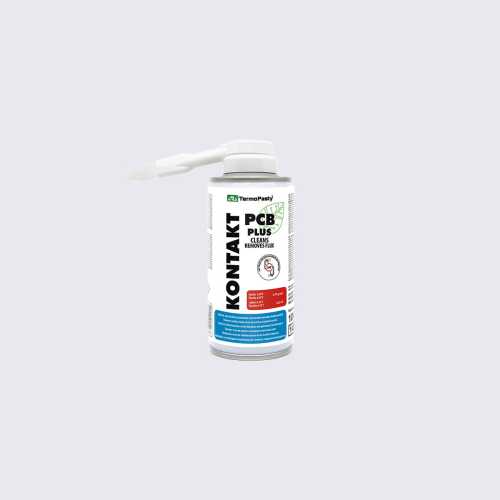
KONTAKT PCB PLUS 100ml – Cleaner and Protector for Printed Circuit Boards (PCB)
Price €7.78Price €6.32 -
WACKER AK 100 30kg – Silicone Oil for Lubrication, Protection and Industrial Applications, Viscosity 100 mm²/s
Zapytaj o cenę Ask about the product
WACKER AK 100 30kg – Silicone Oil for Lubrication, Protection and Industrial Applications, Viscosity 100 mm²/s -
WACKER AK 100 5kg – Silicone Oil for Lubrication, Protection and Industrial Applications, Viscosity 100 mm²/s
Zapytaj o cenę Ask about the product
WACKER AK 100 5kg – Silicone Oil for Lubrication, Protection and Industrial Applications, Viscosity 100 mm²/s -

WACKER SILRES HK46 25kg – High-Temperature Silicone Resin, Heat-Resistant and Non-Stick Binder up to 600°C with Food Contact Compliance
Zapytaj o cenę Ask about the product
WACKER SILRES HK46 25kg – High-Temperature Silicone Resin, Heat-Resistant and Non-Stick Binder up to 600°C with Food Contact Compliance -
Bestseller
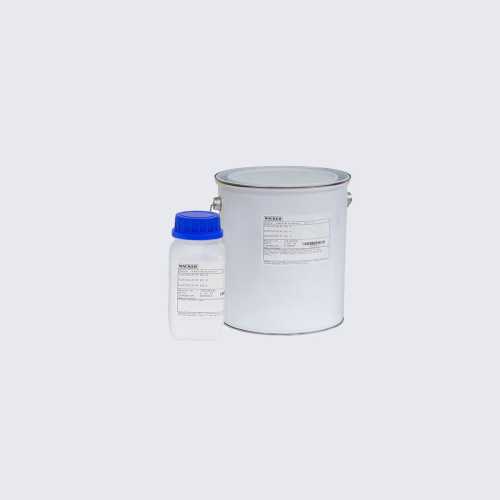
WACKER ELASTOSIL RT 622 A/B 1kg – Silicone for Electronics and Winding Encapsulation, Shore A 27
Price €100.04Price €81.34 -
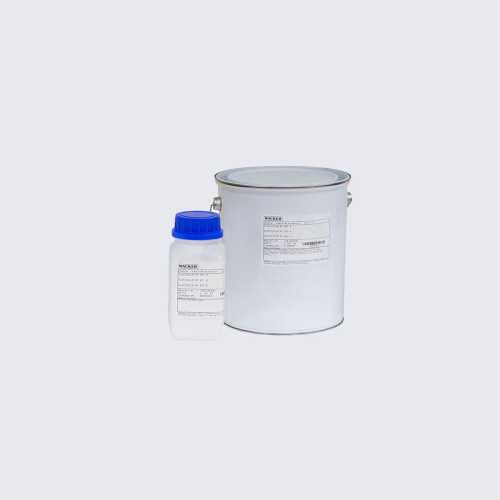
WACKER ELASTOSIL RT 625 A/B 1kg – Silicone for Casting, Electronics Encapsulation and Component Protection, Shore A 25
Price €147.32Price €119.77


