

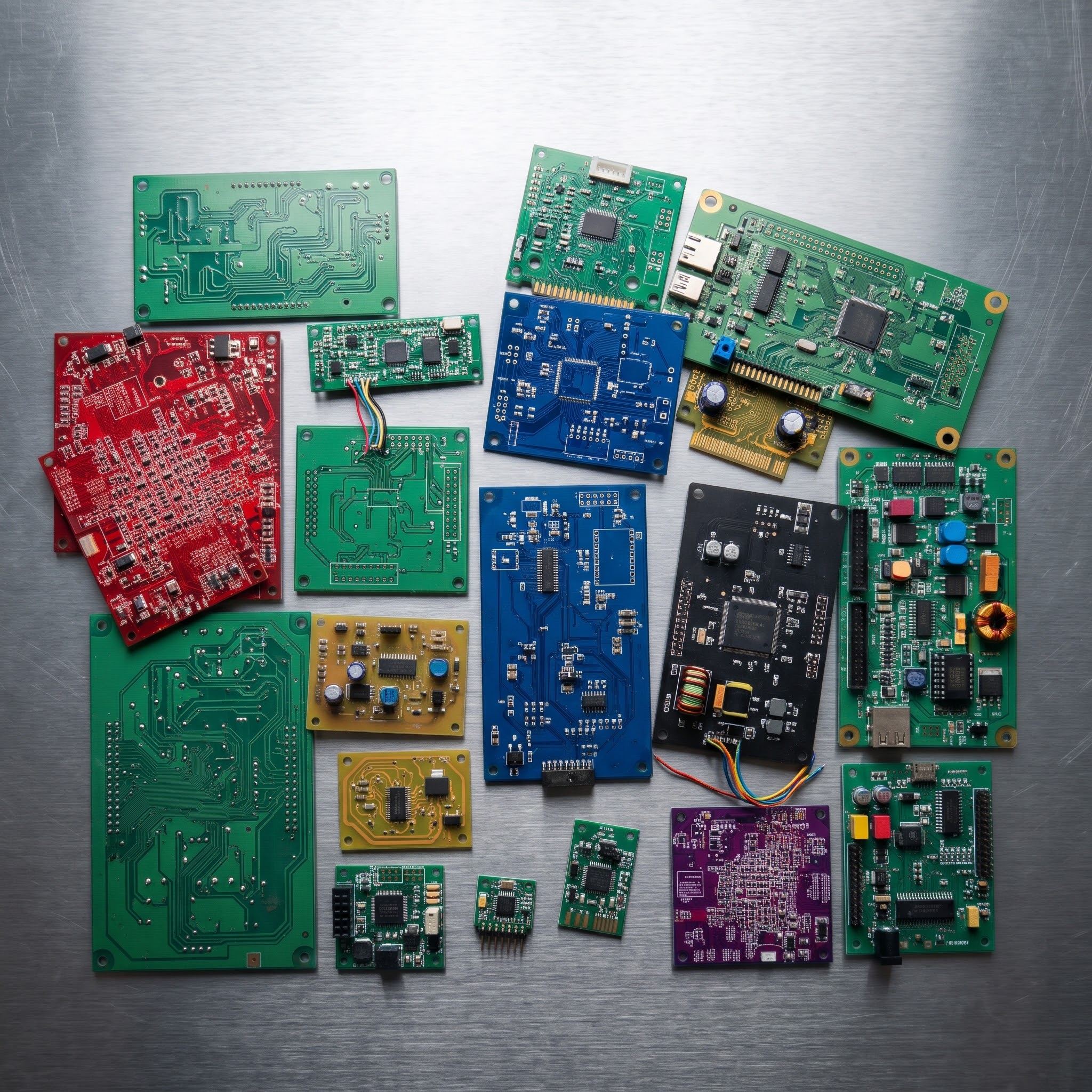
Potting electronics is one of those jobs you can’t “touch up a bit” afterwards. The compound flows into every gap, wraps around the components and stays with them for years. So before you open the can, it’s worth answering one question: do you just want to cushion the components in a soft gel, or encase them in a flexible but solid block of rubber? That decision determines resistance to moisture and vibration, reparability and even how much heat gets out of the circuit.
Gel or compound? What is the actual difference
Both are two-part RTV-2 silicones, and the ones we cover here are addition-cure (platinum-catalysed). The difference lies in what you get after curing:
- Silicone gel (e.g. WACKER SilGel 612, WACKER SilGel 613) – very soft, tacky to the touch, “jelly-like”. Its hardness is no longer measured in Shore A but by penetration.
- RTV-2 potting compound (e.g. ELASTOSIL RT 601, RT 604, RT 622, RT 607, RT 675) – a flexible rubber ranging from approx. 25 Shore A (RT 604) to 80 Shore A (RT 675).
Moisture and vibration
A gel adheres very well and, thanks to its natural tack, “sticks” to the board, so water has nowhere to creep in. It is also excellent at damping vibration – SilGel 613 is actually designed as a damping material. An RTV-2 compound forms a sealed, mechanically robust block: it handles impact, touch and dirt better, and its surface doesn’t collect dust.
Reparability
Here the gel wins hands down. You can dig a component out of gel, replace it and fill the hole with fresh gel. A soft compound (RT 604, RT 622) can also be cut out with a knife, but that is surgical work. A hard compound like RT 675 practically rules out servicing – you have to accept that at the design stage.
Stress on components and wires
The harder the compound, the more firmly it “grips” the components as the whole assembly expands with temperature. With fine bond wires, thin leads, sensors or SMD components on long leads, a gel transmits practically no stress. A hard compound adds rigidity, but under thermal cycling it can load the solder joints.
Heat dissipation
Standard gels and compounds are poor heat conductors – approx. 0.2 W/(m·K), i.e. only slightly better than plastic. If the circuit runs hot (power supplies, converters, coils, battery modules), go for a filled compound: ELASTOSIL RT 675 has a thermal conductivity of approx. 1.2 W/(m·K), but it is hard (80 Shore A) and dense (2.3 g/cm³).
Comparison at a glance
| Type | Hardness | Repair | Stress | Heat | Examples |
|---|---|---|---|---|---|
| Silicone gel | very soft, tacky | easy | minimal | approx. 0.2 W/(m·K) | SilGel 612, SilGel 613 |
| Soft/medium RTV-2 compound | 25–55 Shore A | possible, more difficult | moderate | approx. 0.2 W/(m·K) | RT 601, RT 604, RT 622, RT 607 |
| Hard thermally conductive compound | 80 Shore A | practically impossible | highest | approx. 1.2 W/(m·K) | RT 675 |
Mix ratio, time, temperature and flowability
- SilGel 612 – mix ratio 1:1, viscosity approx. 1000 mPa·s, pot life approx. 150 min, cures at room temperature (approx. 8 h) or faster with heat (1 h at 100 °C). You can adjust the hardness via the ratio: less component B gives a harder, less tacky gel.
- SilGel 613 – mix ratio 10:1, only approx. 200 mPa·s once mixed, so it pours almost like water. With CAT PT catalyst the pot life is approx. 60 min.
- RT 604 – 9:1, mix approx. 800 mPa·s, clear, 25 Shore A, pot life approx. 90 min.
- RT 601 – 9:1, approx. 3500 mPa·s, clear, 45 Shore A, approx. 90 min.
- RT 622 – 9:1, approx. 12,000 mPa·s, 27 Shore A, approx. 60 min, very high elongation.
- RT 607 – 9:1, approx. 10,000 mPa·s, 55 Shore A, flame-retardant.
- RT 675 – 1:1, approx. 50,000 mPa·s, pot life approx. 150 min.
The 9:1 compounds cure at room temperature in approx. 24 h, and in an oven in approx. 30 min at 150 °C. Keep in mind that the time depends on the size of the part and how much heat the housing draws away. The thicker compounds (RT 622, RT 675) are best poured from the bottom up and vacuum degassed, because bubbles like to stay trapped under components. You can shorten pot life by adding Catalyst EP and extend it by adding Inhibitor PT 88.
Inhibition – the silent enemy of addition-cure silicones
The platinum catalyst is easily “poisoned”. When that happens, the compound stays tacky at the substrate or doesn’t cure at all. Watch out for:
- materials containing sulphur (some rubbers, O-rings),
- plasticisers and polyurethanes,
- compounds containing amines (e.g. epoxy hardeners),
- organometallic compounds, especially organotin ones – including residues of condensation-cure silicones,
- flux residues and coatings on the board.
Rule of thumb: test every new board, housing and coating with a small trial. Also never use tools that have touched the catalyst-containing component for pure component B – even a trace of platinum can make it gel in the can.
UL 94 – what does V-0 really mean?
UL 94 describes how a material behaves in a flame. V-0 means the specimen extinguishes itself within a short time after the flame is removed and does not drip flaming particles. It does not mean the material is non-flammable. The HB rating only means slow burning in the horizontal position. If your product has to meet flammability requirements, choose a flame-retardant compound such as RT 607 (used, among others, in railway applications), and check which rating is required for your wall thickness.
Typical applications
- Gels (SilGel 612, 613): automotive electronics, sensors, power modules, damping elements, assemblies that service technicians need to open.
- Clear compounds (RT 601, RT 604): controllers and LEDs where you want to see the components, PCB protection.
- RT 622: potting windings, general potting and technical castings.
- RT 607: coils, windings, applications with flammability requirements.
- RT 675: power supplies, converters, coils and battery modules that need cooling.
Selection checklist
- Will you service the circuit? → gel (SilGel 612 or 613).
- Are there fine bond wires, sensors, long leads? → gel or soft compound (RT 604).
- Does the circuit run hot? → RT 675.
- Does flammability matter? → RT 607, and confirm the rating for your thickness.
- Do you want to see the components? → SilGel 612, RT 604, RT 601.
- Narrow gaps? → low viscosity: SilGel 613, RT 604.
- Do you have an oven? → you can cut curing to approx. 30 min.
- Run an inhibition test on the board, coating and housing.
FAQ
Is a gel enough outdoors?Yes, as long as the housing protects it from damage. Gel doesn’t like direct touch or abrasion.
Can I cover the gel with a harder layer?Yes. You can cover the tacky gel surface with a thin layer of RT 601 to get a dry, tack-free surface.
Why didn’t the compound cure next to the board?Most often it’s inhibition: flux, coating, sulphur-containing rubber or residues of condensation-cure silicone.
Is a V-0 silicone non-flammable?No. V-0 means self-extinguishing, not non-flammable.
Summary
Gel is the choice for delicate, serviceable assemblies, a soft compound for robust protection, and a hard thermally conductive compound for power electronics. First decide whether you will ever need to get to the components and whether the circuit runs hot. The rest is a matter of choosing viscosity and mix ratio.
Not sure which to choose? E-mail us at info@silray.pl or call +48 691 781 725 – describe your assembly, potting dimensions and operating temperature, and we’ll help you choose the right gel or compound.