

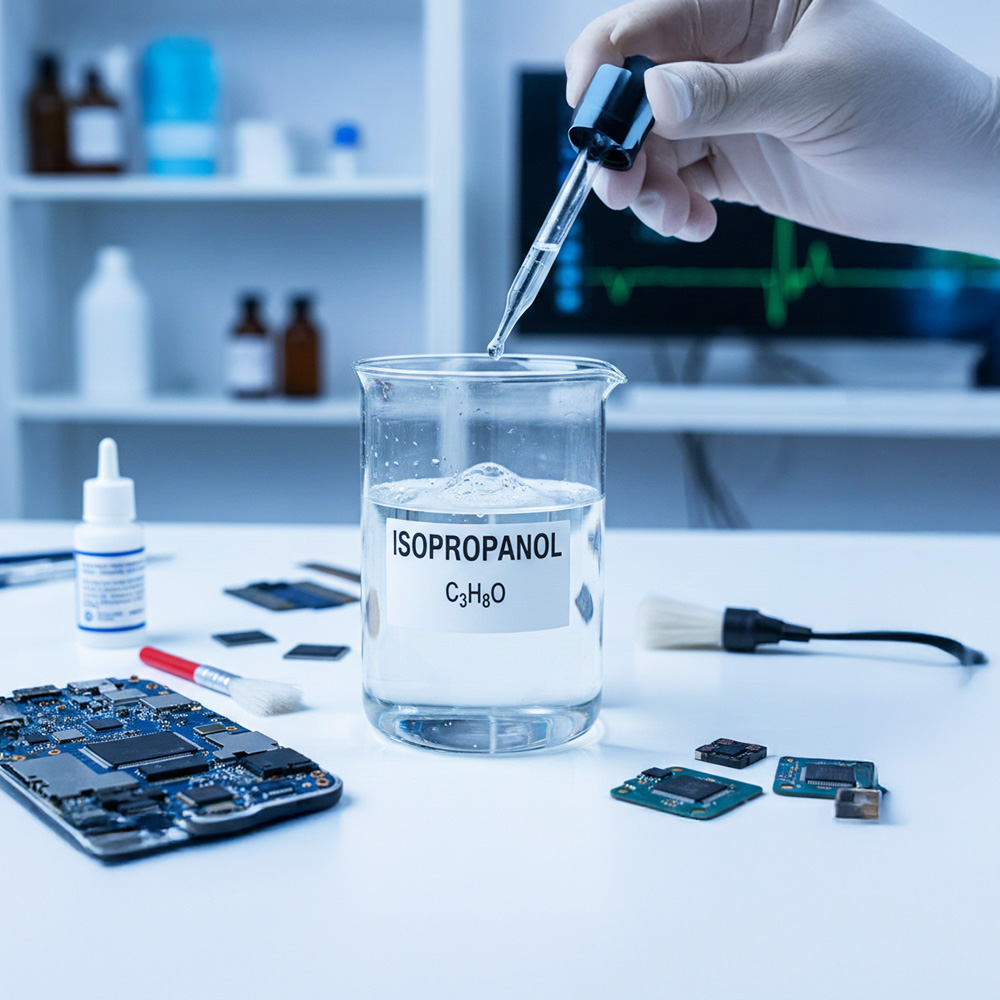
Isopropanol — The Quiet Hero of Everyday Life. From Electronics to the Pandemic: Why IPA Has Become Essential in the Modern World
Just a few years ago, isopropanol (IPA) was associated mainly with laboratories, electronic servicing, and industrial environments. It was a tool for professionals — technicians, engineers, and automation specialists. However, the COVID-19 pandemic turned this unassuming alcohol into one of the most widely recognized chemical substances in the world — finding its way into homes, offices, shops, workshops, and medical facilities.
Today, it is hard to imagine modern technology, servicing, and hygiene without isopropanol. Its versatility makes it at once a cleaning agent, degreaser, disinfectant component, and a trusted ally in precision applications.
Why is isopropanol so universal?
The secret of IPA lies in its chemical properties:
-
it evaporates quickly and leaves no streaks,
-
it is chemically neutral to most materials,
-
it does not conduct electricity,
-
it effectively dissolves grease, contaminants, and residues,
-
it is safe when used correctly.
Thanks to these qualities, it can be used wherever other agents fail or create a risk of damage.
Electronics and technology — where precision matters
In the world of electronics, isopropanol is an absolute standard. It is used for:
-
cleaning PCBs and assembly components,
-
degreasing surfaces before soldering,
-
maintaining connectors, sockets, and switches,
-
removing flux residues,
-
cleaning AV mechanisms and sensors.
Technicians choose IPA because it cleans thoroughly without causing damage — and without the risk of corrosion or electrical conductivity.
Workshops, industry, and servicing — one product, many applications
Isopropanol is also widely used:
-
in precision mechanics and automation,
-
when preparing surfaces for bonding or painting,
-
for cleaning tools and assembly parts,
-
in printing facilities and production plants,
-
in optics and measuring instruments.
In many companies, it has become a “first-choice solution,” combining effectiveness with safety.
The COVID-19 pandemic — the moment IPA moved from laboratories into everyday life
Until 2020, isopropanol was, for most people, something “technical.” The pandemic changed that completely.
IPA became the base for:
-
hand disinfectants,
-
surface cleaning solutions,
-
hygiene measures in offices, shops, and workplaces.
At that time, the world was reminded of the crucial role that applied chemistry plays — not only in industry, but also in health protection and safety.
Household applications — where effectiveness matters without compromise
Isopropanol is increasingly used at home as well, for example for:
-
cleaning screens and smartphones,
-
degreasing bicycle parts or sports equipment,
-
removing glue, marker traces, and dirt,
-
maintaining DIY electronic equipment.
It is a product that — when used responsibly — can replace several different cleaners.
Safety and good practices
Although IPA is safe in technical applications, a few rules should always be followed:
-
use it in well-ventilated areas,
-
keep it away from open flames — it is highly flammable,
-
avoid contact with eyes and skin,
-
store it in a tightly sealed container.
Responsible use = maximum efficiency and full safety.
Isopropanol — a substance that connects the worlds of technology and everyday life
The story of IPA shows that a seemingly simple chemical compound can play a major role:
-
in industry and electronics,
-
in servicing and production,
-
in hygiene and safety,
-
in everyday life.
It is an example of chemistry that rarely draws attention — yet without it, the modern world would look completely different.
 Log in with Facebook
 Log in with Google