

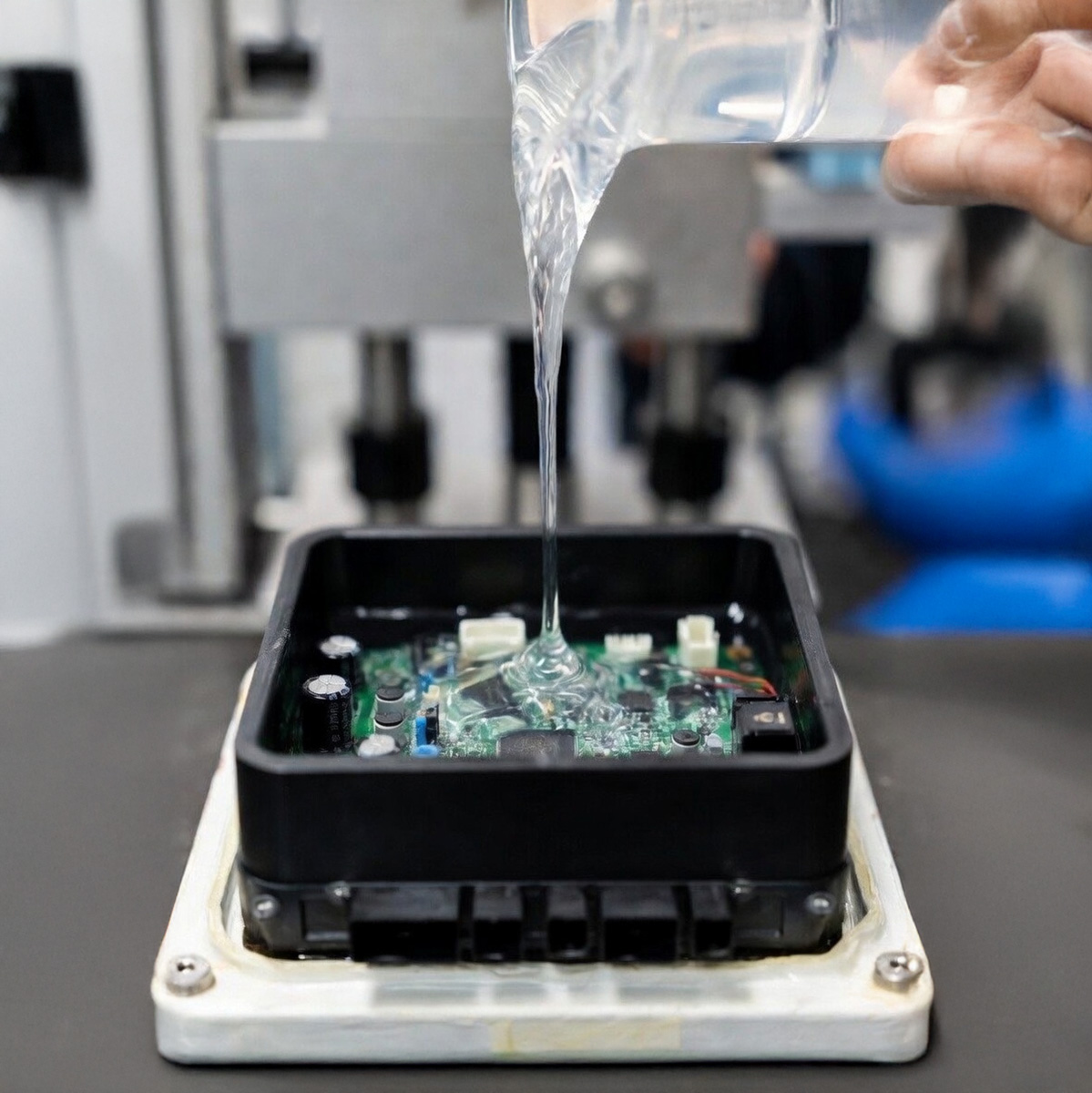
Modern electronics leaves no room for compromise. Miniaturization makes components increasingly delicate, while simultaneously demanding them to operate in ever harsher conditions—surrounded by strong vibrations, moisture, and rapid temperature fluctuations. Engineers quickly realized that traditional, rigid epoxy or polyurethane potting compounds often lead to a dead end. Instead of protecting, they transfer thermal stress onto delicate connections, leading to the tearing of wire bonds and the failure of entire electronic assemblies.
The solution to this problem turned out to be silicone gels. In this elite group of materials, the battle for the leading position has been ongoing for years. And although the market has grown accustomed to a few standard names, more and more electronics manufacturers (EMS) and R&D departments are switching to WACKER SilGel® 612. Why? Because it offers stability and parameters that competitors struggle to match.
SilGel® 612: The anatomy of the perfect shock absorber
Before we move on to comparisons, it is worth understanding what exactly SilGel 612 is. It is a two-component (RTV-2), addition-curing silicone gel. Its purpose is not the mechanical stiffening of the assembly, but rather total vibration absorption and environmental insulation.
What makes it so special?
-
Extremely low viscosity (approx. 1,000 mPa·s): The material flows like water. It penetrates the tiniest gaps under SMD and BGA components, effectively displacing air without the need for prolonged vacuum degassing.
-
Softness beyond the Shore scale: Cured SilGel 612 is not measured in Shore A hardness. It is so soft that it is tested using a penetrometer. Thanks to this, it introduces absolutely zero thermomechanical stress into the assembly, compensating for the differences in thermal expansion between the PCB and the components.
-
Crystal clear transparency: It allows for easy visual inspection of the assembly after potting, as well as the trouble-free insertion of measuring probes for service purposes (the gel has a so-called shape memory and "self-heals" after the probe is removed).
What does SilGel® 612 replace? (A direct clash)
Many electronics manufacturers have been stuck in the trap of being "accustomed" to a single supplier for years. SilGel 612 was designed to seamlessly replace the most popular dielectric gels on the market, often offering better processing and logistical parameters in the process.
Here are the materials you can successfully replace with the WACKER product:
-
DOWSIL™ Sylgard 527: This is the most common target for a switch. Sylgard 527 is a market classic, but in an era of global supply chain instability and price fluctuations, SilGel 612 is emerging as its powerful European rival. It offers extremely similar viscosity and penetration parameters, but users often point out better batch-to-batch repeatability and a smoother curing process with Wacker.
-
Momentive TSE3051: The well-known transparent gel from Momentive. SilGel 612 is a perfect alternative, offering very similar electrical insulation properties, but often with a more user-friendly processing window (pot life), which facilitates work on production lines.
-
Shin-Etsu KE-1051 / KE-1052: Popular gels in the automotive industry. WACKER, as a brand with a massive reputation in the European automotive sector, provides a more logistically stable alternative with SilGel 612, featuring outstanding resistance to thermal cycling.
-
Elkem Bluesil™ ESA 7242: Much like the Elkem product, SilGel 612 provides excellent protection against stress, but Wacker's formulation often wins out in long-term dielectric aging tests.
Why is switching to SilGel® 612 a smart move?
Convincing the quality department to change a key material is never easy, but the arguments behind WACKER SilGel 612 are hard to refute:
-
Zero chemical shrinkage: Unlike cheaper solutions, the WACKER addition-curing system has no shrinkage. You fill the mold to the brim, and you are guaranteed that after curing, the material will not "pull back", expose connections, or warp the delicate board.
-
European Supply Chain (Supply Chain Security): WACKER is a German giant that manufactures its key raw materials in Europe. For production plants, this means the end of multi-week delays in deliveries from overseas or Asia.
-
Curing flexibility: You can cure it at room temperature (saving energy) or drastically speed up the process in an oven (e.g., 15 minutes at 100°C), allowing it to seamlessly match the rhythm of the production line.
-
Dielectric purity: SilGel 612 is characterized by outstanding resistance to electrical breakdown and low moisture absorption, which is crucial in modern power electronics and renewable energy systems (RES).
WACKER SilGel® 612 is not just another silicone. It is an advanced armor for electronics that protects them in the smartest way possible—yielding under pressure (vibrations, temperature) instead of putting up rigid resistance.
If your current dielectric gel supplier is having trouble with deadlines, raising prices, or if you are struggling with assembly failures due to stress—it is time for testing. Changing the "status quo" in production takes courage, but in the case of SilGel 612, this decision defends itself at every stage—from application to years of trouble-free device operation for the end customer.
 Log in with Facebook
 Log in with Google