

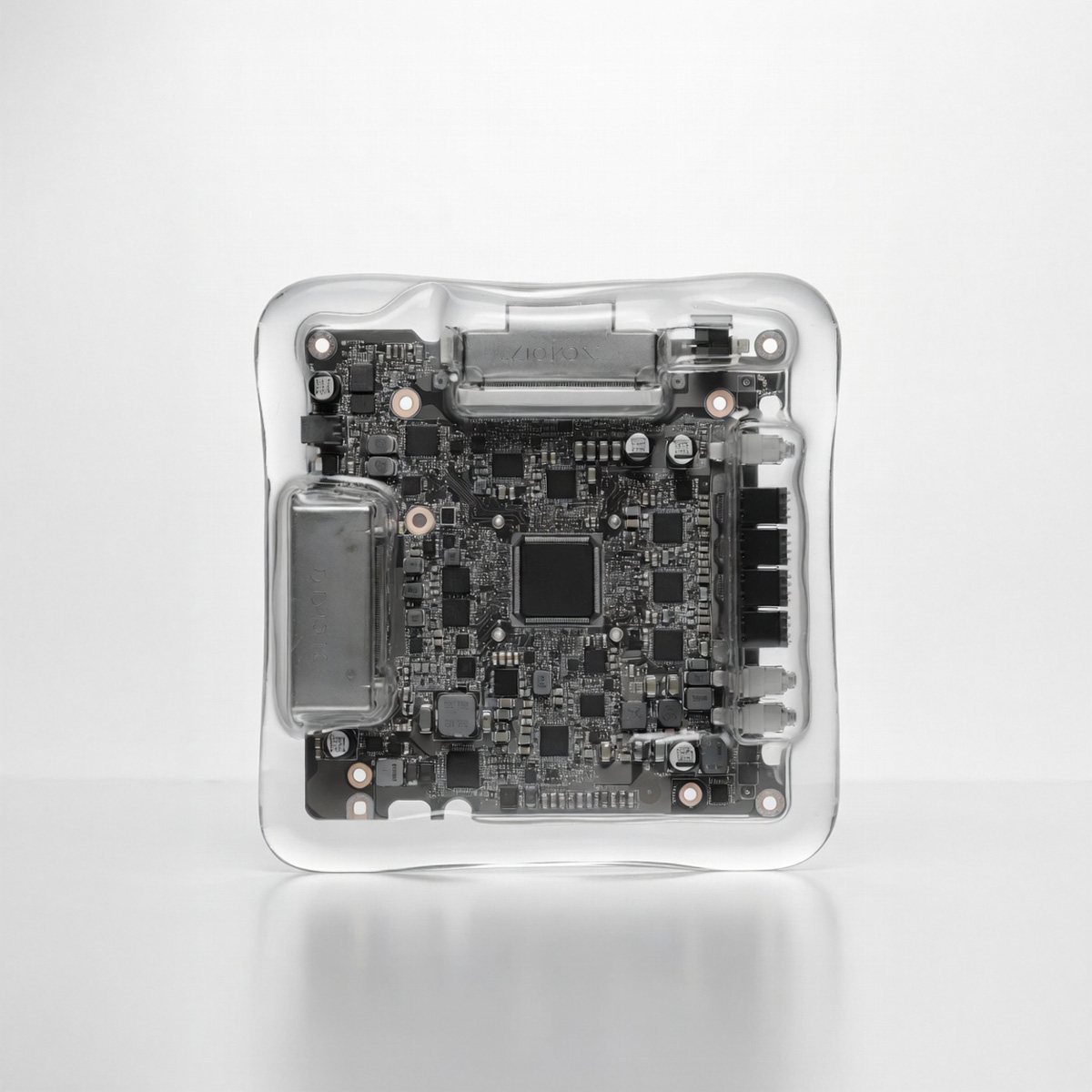
WACKER SilGel® 612 A/B is one of the most popular silicone gels for professional electronics encapsulation. Thanks to its extremely low hardness, low viscosity, and simple 1:1 mixing ratio, it is the first choice for automotive integrators, power electronics manufacturers, solar installers, and companies producing vibration-damping elements.
In this practical guide, we will show you exactly how to mix and cure SilGel 612 to achieve perfect results every time. We will focus particularly on the two most common problems – when the gel turns out too soft and tacky, and when the surface remains sticky.
Before you even reach for components A and B, proper preparation is essential. The surface must be absolutely clean and dry – free from any traces of oil, grease, sulfur, plasticizers, urethanes, amines, or organometallic compounds. If you’re unsure whether the substrate might inhibit curing, always perform a small compatibility test first. Remember that component B contains the platinum catalyst, so even the smallest traces can cause gelling of component A (which contains the crosslinker). Always use batches of A and B with the same lot number – this is the basic rule to ensure full compatibility.
Mixing is simple and intuitive. Maintain an exact 1:1 weight or volume ratio. The catalyzed mixture has a very low viscosity of just 1000 mPa·s, making it easy to pour even into complex molds. You have up to 150 minutes of pot life at room temperature, giving you plenty of time for precise pouring and degassing. Mix mechanically with a low-speed stirrer for 2–3 minutes until fully homogeneous, but avoid introducing too much air. After mixing, vacuum degassing is essential – this key step removes air bubbles and ensures excellent insulation.
Curing time depends on temperature, layer thickness, and the thermal properties of the component being potted. At room temperature (approx. 23°C), the full process takes about 8 hours. To speed things up, place the mold in a circulating air oven at 100°C – curing will then take only 15 minutes. At 150°C, it takes just 5 minutes. You achieve the full mechanical and electrical properties, including a volume resistivity of 10¹⁵ Ohm·cm and a dielectric constant of 2.7, only after complete curing.
The most common issue occurs when the cured gel is too soft and tacky. According to the manufacturer, this happens with the standard 1:1 ratio. The solution is simple – reduce the amount of component B. The hardest and least tacky formulation is achieved at a ratio of approximately 1.5:1 (A:B). In practice, instead of 100 g A + 100 g B, use 150 g A + 100 g B. The effect is noticeable: the gel becomes significantly firmer and the surface much less sticky. Please note that for logistical reasons, WACKER only accepts orders in the standard 1:1 ratio, so you make this adjustment yourself during mixing.
If you want a completely dry, non-tacky surface, apply a thin layer of ELASTOSIL® RT 601 after curing – by brush or spray. This proven trick delivers a perfect tack-free finish without affecting the main gel’s properties.
Sometimes the gel cures too slowly or too quickly. In such cases, simply use the dedicated additives. ELASTOSIL® Catalyst EP increases reactivity and shortens both pot life and curing time. Inhibitor PT 88 works in the opposite way – it extends working time and curing time. Start with dosages of 0.1–1% and always test on a small batch. Pigmenting is just as easy: add 1–4% of ELASTOSIL® FL pigment paste – the color has no significant effect on reactivity.
In practice, SilGel 612 performs excellently for encapsulating ECU and PCU modules – mix at 1:1, degas, and cure at 100°C for 15 minutes to get perfect protection against vibration and moisture while maintaining 94 HB flame retardancy. For solar panels, many integrators deliberately switch to a 1.5:1 ratio for slightly higher rigidity and then protect the surface with RT 601. For vibration-damping elements, the standard 1:1 ratio provides the lowest possible hardness, which absorbs vibrations perfectly.
Many users ask whether SilGel 612 can be mixed by hand. For small quantities, yes – but above 500 ml, it is much better to use a mechanical mixer and vacuum degassing. If the gel does not cure at all, the cause is almost always inhibition due to surface contamination – which is why a small test is so important. And what’s the difference between original SilGel 612 and cheaper Chinese alternatives? Above all, batch-to-batch consistency, the guarantee of an original platinum catalyst, and full compatibility with automotive and power electronics requirements.
In summary, the key to a perfect vulcanizate is a clean surface, precise mixing, thorough degassing, and the conscious selection of ratios or additives. This way, SilGel 612 always delivers its exceptional properties – extremely low hardness, excellent adhesion, and the highest level of insulation.
Want to achieve repeatable, professional results every time? Choose the original WACKER SilGel® 612 A/B available at Silray.pl. There you will find not only the product, but also full technical support and confidence in its authenticity.
Have questions about a specific application? Write a comment or contact Silray’s technical department directly – we will help you choose the perfect proportions and additives for your needs.
 Log in with Facebook
 Log in with Google