

What is the ELASTOSIL VARIO system?
ELASTOSIL VARIO is a range of pourable, addition-curing, two-component RTV-2 silicones that vulcanize at room temperature. It is a modular system: two bases and two catalysts. Its main applications are industrial replication molds and food molds, as well as prototyping. Both silicones resist common casting materials – casting resins, concrete and plaster – and cure with no chemical shrinkage, giving highly accurate copies of the master model.
ELASTOSIL VARIO 15 – the soft base
ELASTOSIL VARIO 15 cures to a hardness of 15 Shore A, with an elongation at break of 900% and a tensile strength of 6.5 N/mm². The base viscosity is 5,000 mPa·s, dropping to just 3,000 mPa·s once the catalyst is added, so it flows easily into fine detail. It complies with FDA and BfR requirements. A soft, highly stretchable mold is ideal for models with undercuts that have to be peeled off the casting.
ELASTOSIL VARIO 40 – the harder base
ELASTOSIL VARIO 40 gives a hardness of 40 Shore A, a tensile strength of 8 N/mm² and an elongation of 450%. The base viscosity is 15,000 mPa·s, and 10,000 mPa·s after mixing with the catalyst. A harder mold holds its shape better – a good choice for simpler geometries and for molds that must be dimensionally stable.
Both bases have a tear strength of 15 N/mm, are translucent and colorless after curing, and can be colored if required by adding 1–4% of ELASTOSIL FL pigment pastes.
VARIO 15 vs VARIO 40: base comparison
| Property | VARIO 15 | VARIO 40 |
|---|---|---|
| Hardness | 15 Shore A | 40 Shore A |
| Base viscosity | 5,000 mPa·s | 15,000 mPa·s |
| Mixed viscosity | 3,000 mPa·s | 10,000 mPa·s |
| Tensile strength | 6.5 N/mm² | 8 N/mm² |
| Elongation at break | 900% | 450% |
| Tear strength | 15 N/mm | 15 N/mm |
| Mix ratio with catalyst | 10 : 1 by weight | 10 : 1 by weight |
How to choose the mold hardness
The greatest advantage of the system is that VARIO 15 and VARIO 40 can be blended with each other to achieve any target hardness in the 15–40 Shore A range. Instead of buying several different silicones, two bases are all you need.
Practical tip: the hardness of the blend depends on the ratio of the two bases. If you need a specific intermediate value, make a small test sample with the chosen base ratio, cure it and check the hardness before you pour a large mold. The catalyst ratio (10:1) stays the same – it is calculated on the combined weight of the bases.
CAT VARIO or CAT VARIO-F? Catalyst comparison
Both bases use the same platinum catalysts at a ratio of 10:1 by weight (100 parts base : 10 parts catalyst). They differ in reactivity:
| Property (23 °C) | CAT VARIO (normal) | CAT VARIO-F (fast) |
|---|---|---|
| Base : catalyst ratio | 10 : 1 by weight | 10 : 1 by weight |
| Pot life (to 100,000 mPa·s) | 150 min | 2 min |
| Demolding time | 6 h | 15 min |
| Best for | large molds, time for de-airing and unhurried pouring | small molds, rapid prototypes, series production |
The values are identical for VARIO 15 and VARIO 40. Mechanical properties refer to silicone cured for 24 h at 23 °C.
Which one to choose? If you are making your first mold, working with a larger volume or want to de-air the compound in a vacuum chamber, choose CAT VARIO: 150 minutes gives you plenty of time. CAT VARIO-F, with a 2-minute pot life, requires brisk work but allows demolding after just 15 minutes. By blending both catalysts you can achieve intermediate times (2–150 min working time, 15 min–6 h to demold) – here too, a test is worthwhile.
How to make a silicone mold step by step
1. Preparing the model and mold box
The model must be clean, dry and firmly fixed to the base so that it does not float up during pouring. Build a mold box (frame) leaving a margin of a few centimeters around the model. Make sure the model and mold box materials do not interfere with the cure of the addition-cure silicone (see inhibition below) – if in doubt, run a test on a small area.
2. Weighing and mixing
Weigh the components on a scale – the 10:1 ratio is by weight, not by volume. For 100 g of base (VARIO 15, VARIO 40 or a blend of both) add 10 g of catalyst. Mix thoroughly, scraping material from the sides and bottom of the container, until the compound is homogeneous.
3. De-airing
Air bubbles stirred in during mixing are best removed in a vacuum chamber. With CAT VARIO there is time for this; with CAT VARIO-F (2 min) vacuum de-airing is very difficult – in practice, use the fast catalyst mainly for small molds.
4. Pouring
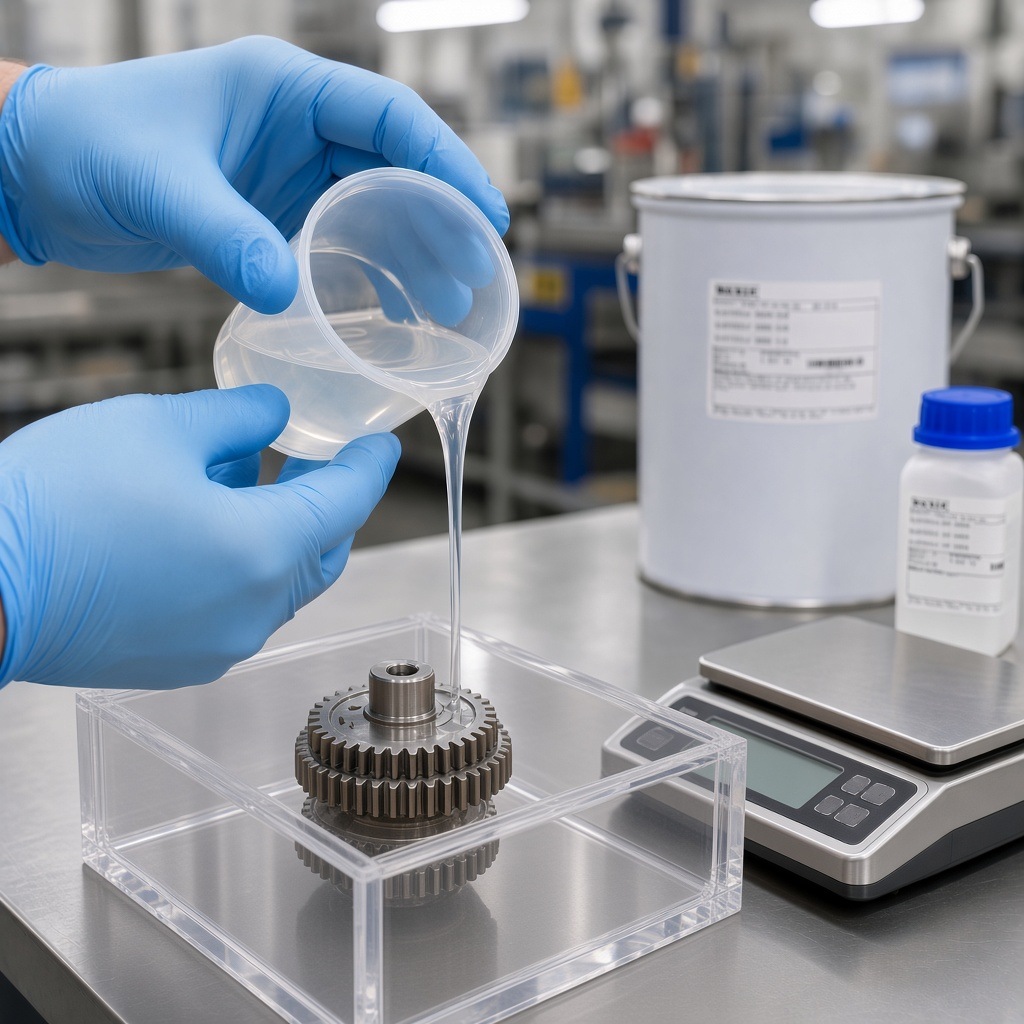
Pour the silicone in a thin stream into the lowest point of the mold box, letting it rise on its own and flow around the model. The low viscosity of the mix (3,000 mPa·s for VARIO 15, 10,000 mPa·s for VARIO 40) makes it easier to fill fine detail.
5. Curing and demolding
At 23 °C the mold can be demolded after 6 h (CAT VARIO) or after 15 min (CAT VARIO-F). The silicone reaches its full mechanical properties after 24 h at 23 °C, so it is worth giving the mold a full day before the first demanding casting.
Most common mistakes
- Inhibition (the silicone does not cure or stays tacky at the model). Addition-cure (platinum) silicones are sensitive to certain substances in the model or the surroundings. Tacky areas at the model surface are a typical symptom. Always run a test on a new model material.
- Bubbles in the mold. They result from overly vigorous mixing, skipping de-airing or pouring from a height. De-air the compound and pour slowly into a single point.
- Wrong mix ratio. Measuring by eye or by volume instead of 10:1 by weight changes the cure time and quality. Use a scale.
- Too fast a catalyst for a large mold. The 2-minute pot life of CAT VARIO-F is too short for a large pour – choose CAT VARIO.
- Curing too briefly. Demolding is possible earlier, but the silicone only reaches its full properties after 24 h.
Before you start, read the safety data sheets (SDS) for each component – the VARIO 15/40 bases and the CAT VARIO and CAT VARIO-F catalysts. They contain the full safety instructions. The sheets can be downloaded from the product pages in the Silray shop.
Need a soft, stretchy mold? Choose VARIO 15. Stable and harder? VARIO 40. Something in between – blend both bases. The working pace is set by the catalyst: CAT VARIO for unhurried work and large molds, or CAT VARIO-F when speed matters.