

Start with the application requirements, not the product number
The ELASTOSIL RT family includes pourable, two-component, addition-curing RTV-2 silicones. A shared curing mechanism does not make them interchangeable. Transparency, hardness, tear strength, mixed viscosity and fire-performance requirements all lead to different choices.
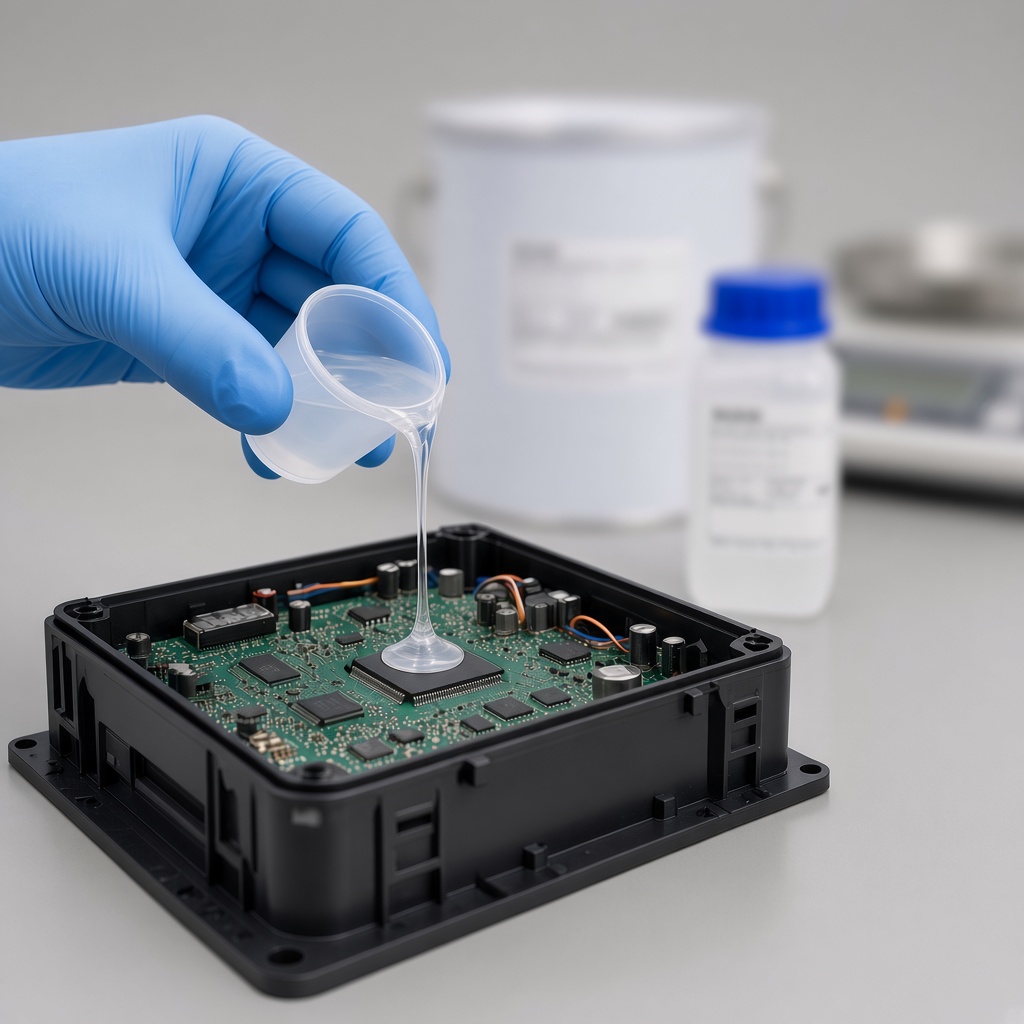
First define what the material needs to do: allow visual inspection of electronics, fill fine gaps, protect a winding in an application with fire-performance requirements, form a mechanically robust casting or help transfer heat. Only then select a product and test it in the actual assembly. If you are still deciding between a solid rubber and a very soft gel, start with our guide Potting Electronics: Silicone Gel or RTV-2 Compound?. Here we focus on choosing between six specific RT silicones and setting up the process.
ELASTOSIL RT 607: when flame retardancy and railway applications matter
ELASTOSIL RT 607 A/B is a reddish-brown potting compound with a hardness of 55 Shore A. It is flame-retardant and meets EN 45545-2:2020 requirements for hazard levels HL1, HL2 and HL3 in requirement sets R22, R23 and R24. That scope matters: it must not be extended to every requirement of the standard or treated as automatic approval of the complete device.
Applications include potting electronics, coils in lifting electromagnets and winding overhangs. This makes ELASTOSIL RT 607 A/B a relevant choice where a defined fire-performance profile is needed as well as enclosure filling. It is not a transparent equivalent of ELASTOSIL RT 601 A/B or ELASTOSIL RT 604 A/B.
The mixture has a viscosity of 10 000 mPa·s at 23 °C, an A:B mixing ratio of 9:1 by weight and a pot life of 80 minutes at 23 °C, measured until viscosity reaches 100 000 mPa·s. When designing the process, account for winding geometry and air removal, not just the nominal working time.
RT 601, RT 602 and RT 604: transparency or general-purpose potting?
RT 601 – transparency and a harder elastomer
Once cured, ELASTOSIL RT 601 A/B is colorless and transparent. It reaches 45 Shore A and a tensile strength of 6 N/mm². Mixed viscosity is 3500 mPa·s at 23 °C. It is intended for general-purpose potting, the production of cast parts, automotive electronics, and measurement and sensor technology. Consider it when visibility of the encapsulated components matters but you need a harder material than ELASTOSIL RT 604 A/B.
RT 604 – low viscosity and a softer, transparent potting compound
ELASTOSIL RT 604 A/B also forms a colorless, transparent elastomer, but its hardness is 25 Shore A and its mixed viscosity is 800 mPa·s – the lowest in this comparison. That is a significant difference when filling small spaces. Low viscosity does not, however, replace bubble control or checking that air can escape from beneath components.
RT 602 – when transparency is not required
ELASTOSIL RT 602 A/B is a light-grey, general-purpose encapsulant with a hardness of 30 Shore A and a mixed viscosity of 3500 mPa·s. Its features include thermal stability and the ability to cure quickly at elevated temperatures. Do not select it on the assumption that every RT 60x is transparent: its cured color distinguishes it from ELASTOSIL RT 601 A/B and ELASTOSIL RT 604 A/B.
RT 625 and RT 675: two different meanings of a “strong” silicone
RT 625 – high elongation and tear resistance
ELASTOSIL RT 625 A/B combines a hardness of 25 Shore A with an elongation at break of 600%, a tensile strength of 6,5 N/mm² and a tear strength of 30 N/mm. It is colorless but translucent, not crystal-clear. Applications include potting electrical and electronic components, coating, molds and technical cast parts.
This illustrates why hardness alone is not enough for selection: ELASTOSIL RT 625 A/B and ELASTOSIL RT 604 A/B are both 25 Shore A, but they are not the same material. For a casting exposed to deformation, also check strength and elongation. Allow for the higher mixed viscosity of ELASTOSIL RT 625 A/B, 12 000 mPa·s at 23 °C, and its shorter pot life of 60 minutes at 23 °C.
RT 675 – heat conduction and high hardness
ELASTOSIL RT 675 A/B is a thermally conductive material intended for applications including batteries, thermal interface materials and electronics potting. Once cured, it is reddish-brown, with a hardness of 80 Shore A and an elongation at break of 20%. It is mixed 1:1 by weight, and its mixed viscosity is 50 000 mPa·s.
It is therefore not a straightforward substitute for a soft, free-flowing potting compound. Thermal performance must be assessed in the finished assembly; selecting a material alone does not determine the operating temperature of a device. For a broader view of thermal selection, see our article Thermal Management in Power Electronics: When is standard ELASTOSIL RT 628 enough, and when do you need to use RT 675?.
ELASTOSIL RT property comparison
Pot life is not the time to full cure. The quoted times refer to different viscosity thresholds, so they do not provide a straightforward ranking of product speed. A temperature of 23 °C is given for the mixed viscosities of RT 601, RT 607 and RT 625; it is not specified separately for the mixed viscosities of RT 602, RT 604 and RT 675. Do not add measurement conditions that are not stated.
| Property | RT 601 | RT 602 | RT 604 | RT 607 | RT 625 | RT 675 |
|---|---|---|---|---|---|---|
| Hardness, Shore A | 45 | 30 | 25 | 55 | 25 | 80 |
| Appearance | colorless, transparent | light grey | colorless, transparent | reddish-brown | colorless, translucent | reddish-brown |
| Tensile strength, N/mm² | 6 | 1,5 | not stated | 3 | 6,5 | 2 |
| Elongation at break, % | 100 | 130 | not stated | 100 | 600 | 20 |
| Thermal conductivity, W/(m·K) | not stated | not stated | not stated | not stated | not stated | not stated |
| Flame retardancy / scope of standard | not stated | not stated | not stated | flame-retardant; EN 45545-2:2020, R22/R23/R24, HL1–HL3 | not stated | not stated |
The cured properties of RT 601, RT 602, RT 604, RT 607 and RT 675 refer to specimens cured for 30 minutes at 150 °C in an air-circulating oven; those of RT 625 refer to specimens compression-molded for 10 minutes at 100 °C. These are specimen preparation conditions for testing, not a universal curing schedule for electronics. Values are indicative, not acceptance specifications. “Not stated” means that the information is not provided, not that a test result was negative.
How to set up a potting process
1. Select the material and test it on the actual substrates
Record the application requirements and choose the material that meets the most important one. Then carry out a small trial using the actual PCB, enclosure or winding. Check cure at the contact surface and filling of difficult-to-reach spaces. For a railway project, compare the required standard requirement set with the scope declared for ELASTOSIL RT 607 A/B. For a thermal application, verify the performance of ELASTOSIL RT 675 A/B in the final design.
2. Prepare the surfaces and components
Surfaces must be clean and free from substances that inhibit crosslinking. For RT 601, RT 602, RT 604, RT 607 and RT 675, these include sulfur compounds, amines, plasticizers, urethanes and organometallic compounds, particularly organotin compounds. Test compatibility when the substrate is unfamiliar. This is a different issue from choosing a one-component sealant type; that topic is covered in our separate guide Acetoxy, Amine or Neutral Silicone for Electronics?.
Only combine components A and B with the same batch number. For RT 602, RT 607 and RT 675, thoroughly stir the components in their containers to redistribute any settled filler; RT 625 also requires thorough stirring of the components before dispensing. Do not assume that a product is homogeneous immediately after prolonged storage.
3. Weigh and mix without changing the ratio
For ELASTOSIL RT 601 A/B, ELASTOSIL RT 602 A/B, ELASTOSIL RT 604 A/B, ELASTOSIL RT 607 A/B and ELASTOSIL RT 625 A/B, maintain 9 parts A to 1 part B by weight; for ELASTOSIL RT 675 A/B, use 1 part A to 1 part B. Do not transfer a recipe between products or increase the amount of component B to speed up the process. Mix the weighed components thoroughly until homogeneous.
Use separate tools for dispensing each component. In RT 601, RT 602, RT 604, RT 607 and RT 675, the platinum catalyst is in component A; in RT 625, it is in component B. Transferring even traces of catalyst to the component containing the crosslinker can cause it to gel. Similar names do not mean identical component systems.
4. Remove air and pour
Vacuum potting is recommended for RT 601, RT 602, RT 604, RT 607 and RT 675 to remove air introduced during dispensing or trapped beneath components. Plan preparation, deaeration and potting within the available pot life. In the trial, check that the compound reaches beneath components and fills the intended gaps completely. Choose vacuum settings and dispensing methods to suit the material and part – do not use one arbitrary setting for the whole family.
5. Cure and inspect before applying loads
For RT 601, RT 602, RT 604, RT 607 and RT 675, curing time depends on temperature, the size of the potted component and its ability to dissipate heat. Do not equate the end of pot life with readiness for service. Nor should you copy the specimen preparation conditions from the table into a process involving sensitive components. Establish the conditions through trials, and check cure and the required properties of the finished assembly before starting production.
Common mistakes and how to avoid them
Selecting solely by Shore A hardness. The same hardness does not mean the same flow or resistance to damage. Consider it alongside viscosity, elongation and application requirements. Ignoring how pot life is measured. The 90 minutes quoted for RT 601 and RT 604 refer to different viscosity thresholds; establish the actual dispensing time through a trial. Contaminating a component or surface. Separate your tools, maintain cleanliness and test compatibility with new materials before a large pour.
Assuming low viscosity guarantees a bubble-free result. Even a thin mixture cannot resolve air trapped beneath a component. Extending the fire-performance declaration. EN 45545-2 for RT 607 covers the specified requirement sets and levels; it does not replace assessment of the finished product. Making a thermal selection without testing the device. Neither high hardness nor the term “thermally conductive” determines the operating temperature of an assembly on its own.
Why specialists choose WACKER silicones
WACKER is one of the world’s largest silicone manufacturers, with materials for electronics, automotive applications, energy and industry. In practical material selection, this means access to different solutions within one family – from transparent potting compounds to materials with enhanced tear resistance, thermal conductivity or a defined fire-performance declaration. The brand alone is not what matters; it is the ability to match properties to the task.
Technical data sheets with test conditions, safety documentation and the manufacturer’s technical support help you develop and verify a process rather than relying on general claims. Always check compliance with a standard for the specific product and declared scope – as in the case of RT 607.
Choose the variant to suit the task
If you need transparency and a harder elastomer, compare your requirements with ELASTOSIL RT 601 A/B; for low viscosity and a softer potting compound, consider ELASTOSIL RT 604 A/B. For general-purpose light-grey encapsulation, consider ELASTOSIL RT 602 A/B. For defined fire-performance requirements and winding potting, ELASTOSIL RT 607 A/B is a starting point; for high elongation and tear resistance, consider ELASTOSIL RT 625 A/B; and for thermal applications, ELASTOSIL RT 675 A/B. Confirm every choice with a trial on your own part.
Before use, read the safety data sheets for both components. The technical data in this comparison come from WACKER manufacturer data sheets available in the files tab on the linked product pages.