

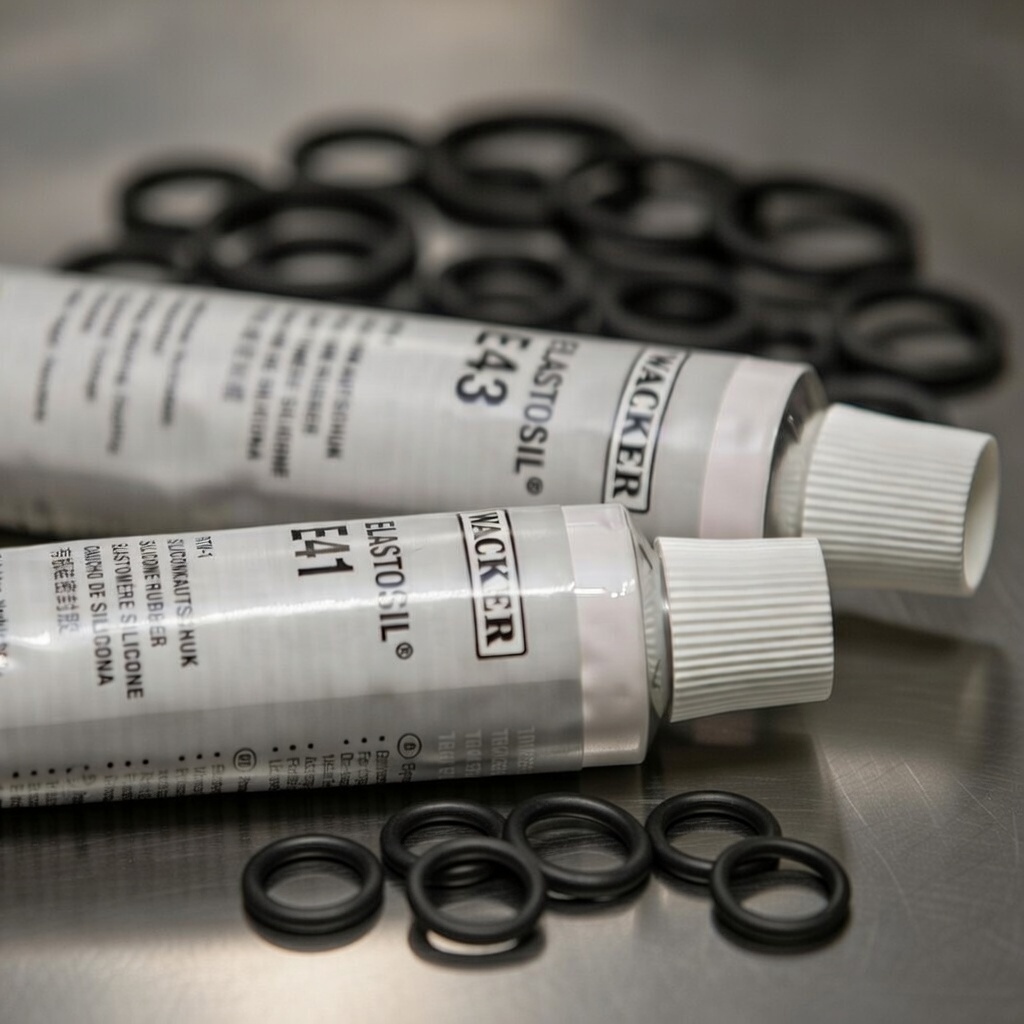
At first glance, two RTV-1 silicones from the same product line may seem to differ only in minor details. Yet engineers, designers, and service technicians know very well that choosing between ELASTOSIL® E41 and ELASTOSIL® E43 can determine the durability, resistance, and reliability of an entire device. So which solution is “better”? It depends—above all on what you intend to use it for.
ELASTOSIL® E41 – the specialist for coating, electronics, and precision applications
E41 is a self-leveling, highly flowable RTV-1 silicone that cures into a clear, elastic, and perfectly even coating. Its unique advantage is excellent adhesion to cured silicones, which sets it apart from typical RTV-1 materials.
This makes E41 ideal for:
-
coating electronics, LED modules, and controllers,
-
thin and precise seals,
-
repair and refurbishment of silicone gaskets,
-
assembly of lighting, optical, and household appliance components,
-
applications where aesthetics and a smooth, transparent layer matter.
E41 is a silicone that flows, levels itself, and forms a protective coating rather than building thick, structural joints.
ELASTOSIL® E43 – a versatile, structural sealant for demanding conditions
E43, on the other hand, is a thicker, thixotropic RTV-1 silicone that does not slump and adheres well to vertical surfaces. It forms strong, elastic, and durable bonds with a more structural character.
It is the material of choice for:
-
classic industrial sealing,
-
assembly and bonding of metal, glass, and ceramic components,
-
sealing housings of devices, machines, and control units,
-
applications exposed to temperature, vibration, and continuous operation,
-
general service and technical work.
E43 is a silicone that builds a joint, holds its shape, and performs better in structural assembly.
E41 vs E43 – two different personalities, one quality DNA
Although both silicones belong to the ELASTOSIL family and offer:
-
high temperature resistance,
-
excellent mechanical properties,
-
resistance to UV and weathering,
-
outstanding durability and flexibility,
they serve entirely different roles in practice.
Which one should you choose? The answer comes down to one question: coating or joint?
If you need a thin, transparent protective layer—for example in lighting, electronics, or silicone refurbishment—choose E41.
If you need a reliable seal or a structural joint resistant to temperature and mechanical stress—choose E43.
Simple? Yes—but only if you understand the difference.
E41 and E43 do not compete with each other—they complement one another, giving users the ability to match the silicone precisely to its role within a device. Both are premium-class materials, but each is designed for a different task. And it is precisely this careful material selection that determines whether a device will operate reliably for years to come.
 Log in with Facebook
 Log in with Google