

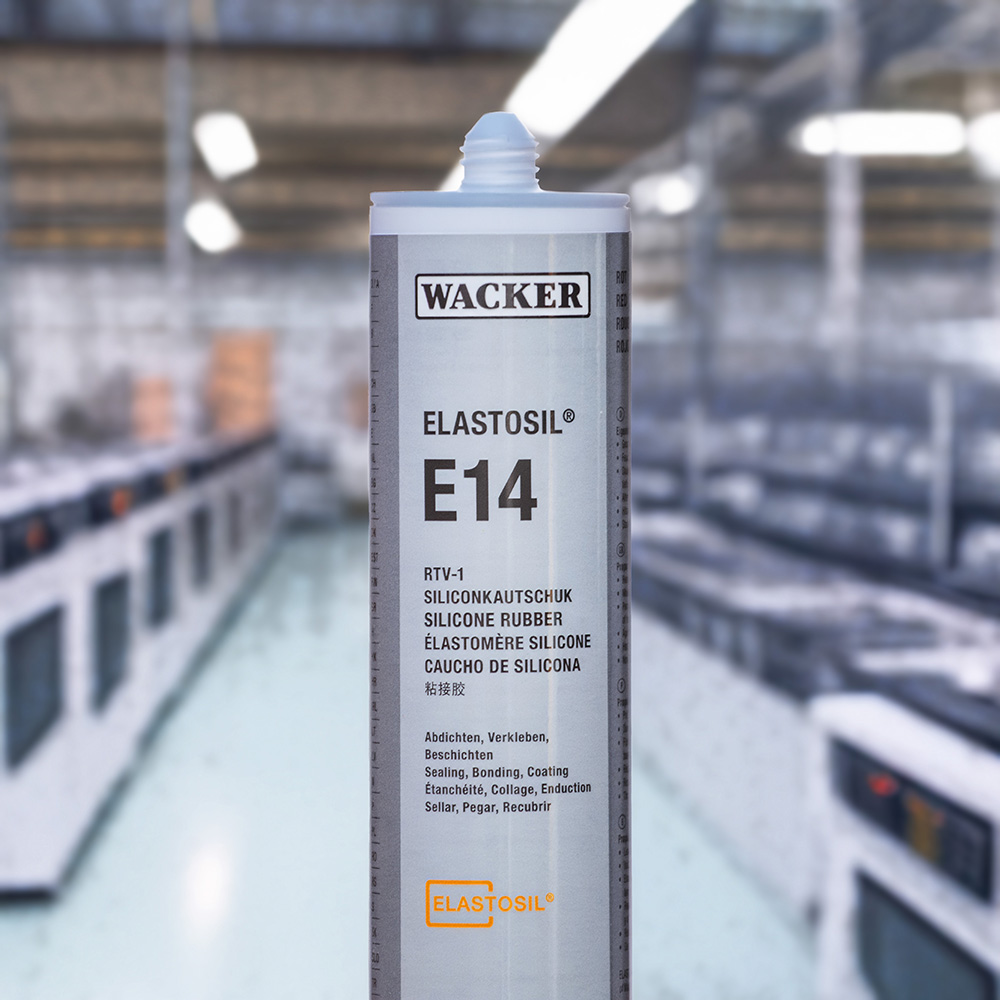
Red high-temperature RTV silicone sealants have been an industry standard for years, widely used in industrial, automotive, and technical service applications. In practice, however, it often turns out that many commonly available products fail to meet expectations under real operating conditions. Poor performance on vertical surfaces, rapid degradation when exposed to heat, and low mechanical strength of the joint are among the most frequent reasons why users seek more durable solutions.
Elastosil® E14 was developed as a highly specialized RTV-1 silicone adhesive for applications where standard “red silicones” prove insufficient. Its performance characteristics and long-term stability have made it an increasingly popular replacement for products from other manufacturers, particularly in applications exposed to high temperatures, vibration, and repeated thermal cycling.
Technological advantage of Elastosil® E14
A key feature of Elastosil® E14 is its heat resistance of up to 250°C while maintaining joint elasticity. Its dense, paste-like consistency allows for precise application without the risk of slumping on vertical surfaces or components installed overhead. In practice, this means full control over bond line thickness and joint stability already at the application stage.
An additional advantage is its very high adhesion to metals and glass, which is critical in industrial applications. Elastosil® E14 complies with the military specification MIL-A-46106, confirming consistent performance and joint quality over long service periods. Unlike many retail-grade products, it is not a compromise solution but a material specifically designed for professional use.
A replacement for common high-temperature silicone sealants
In many cases, Elastosil® E14 effectively replaces standard high-temperature silicone sealants available in DIY and construction stores. Such products often offer only nominal heat resistance while providing low mechanical strength and poor adhesion to substrates. E14 delivers significantly stronger bonding, greater resistance to ageing, and stable performance even after repeated heating and cooling cycles.
For this reason, E14 is increasingly chosen in applications where previous solutions required frequent rework or caused service downtime.
An alternative to products from well-known manufacturers
Elastosil® E14 is also used as a direct alternative to high-temperature silicone sealants from brands such as DOWSIL™, Momentive™, and Loctite®. Compared to DOWSIL™ 732 (Red), E14 offers higher viscosity, making it easier to apply on vertical surfaces and complex geometries. When compared with Momentive RTV 106, it provides similar thermal and mechanical properties while offering improved application stability.
In comparisons with Loctite® SI 596, industrial users often point to reduced shrinkage and better retention of elastic properties over time. These characteristics are decisive factors in selecting E14 for aerospace, machinery, and heating equipment applications.
Use instead of liquid gaskets and high-temperature sealing compounds
Elastosil® E14 performs very well as a replacement for conventional liquid gaskets (“gasket makers”), particularly in automotive and household appliance service applications. Unlike many standard sealing compounds, it does not lose elasticity when exposed to heat and does not become brittle after a few heating cycles.
The product is commonly used for sealing ovens, cooktops, valve covers, and components operating at elevated temperatures where a thicker, stable joint is required. The elastic structure of the cured silicone effectively compensates for thermal expansion and dampens vibration, significantly extending the service life of the joint.
When Elastosil® E14 is a better choice than Elastosil® E43
Although Elastosil® E14 and E43 come from the same manufacturer, they are intended for different types of applications. E14 is preferred wherever operating temperatures exceed 180°C and where maintaining the material exactly at the point of application is critical. Unlike the self-leveling E43, E14 retains its shape on vertical surfaces and in overhead installations.
Why Elastosil® E14 is worth considering as a replacement product
In industrial practice, selecting the right high-temperature silicone sealant is not limited to declared temperature resistance alone. Joint durability, vibration resistance, and long-term stability are equally important. Elastosil® E14 addresses these requirements, eliminating problems typical of lower-cost or general-purpose solutions.
For users seeking a genuine alternative to products from other manufacturers, E14 is a solution well worth testing first. The difference becomes apparent not in technical datasheets, but in the long-term reliability of the bonded joint.
 Log in with Facebook
 Log in with Google