

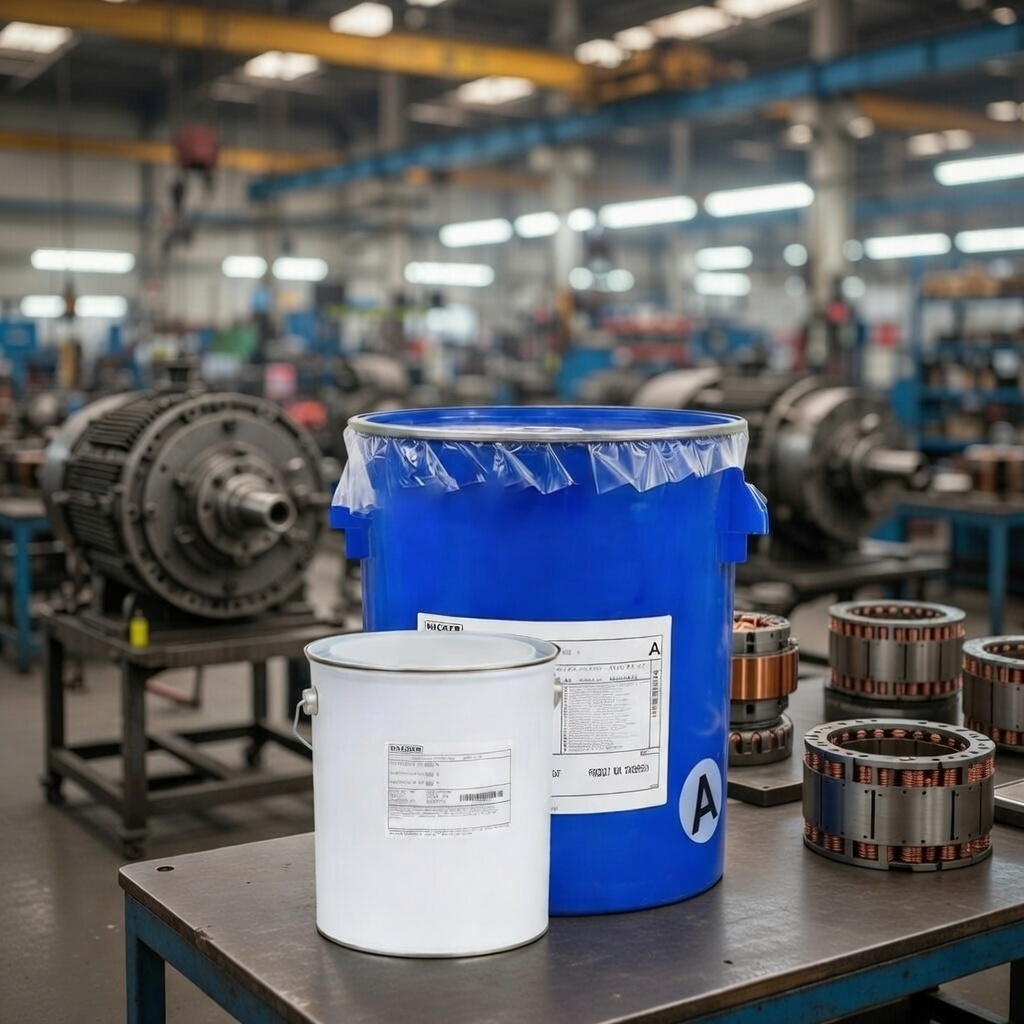
Why ELASTOSIL® RT 622?
Traction motor repair is one of the most demanding tasks in the maintenance industry. These devices operate under conditions that are simply destructive for most materials: constant vibration, heavy overloads, exposure to moisture, dust, and temperature fluctuations, combined with massive differences in thermal expansion between steel, copper, insulation, and electronic components. Each of these phenomena is difficult to manage on its own; in a traction motor, they occur simultaneously—day after day, for many years. It is no surprise that traditional rigid-curing varnishes and resins often fail, transferring stress to wires, solder joints, and control modules. This is why ELASTOSIL® RT 622, an RTV-2 silicone, has gained immense popularity in recent years, serving as an incredibly effective, flexible protective barrier in traction repairs.
RT 622 stands out primarily due to its soft structure after curing. Unlike rigid resins that lock elements in a hard shell, this silicone forms a soft, flexible elastomer that adapts to the movement of components instead of restricting them. Thanks to its low viscosity, it can penetrate deep between windings, wires, and structural elements, filling gaps and stabilizing them without excessive stiffening. This is crucial in traction motors, where vibrations destroy insulation, loosen wires, and lead to solder joint cracks. The soft potting acts as a shock absorber, absorbing energy and protecting elements from micro-damage that leads to serious failures over time.
This silicone is also excellent for protecting temperature sensors, measuring modules, and any electronic components operating inside the motor. The high thermal stability of RT 622 allows for continuous use in conditions where other materials lose flexibility or begin to degrade. Meanwhile, its minimal shrinkage during curing ensures that solder joints and delicate wires are not subjected to additional stress. As a result, sensor modules and electrical connections maintain their integrity even during intensive vehicle operation.
In traction service centers, RT 622 is often used not only for typical potting but also for insulation regeneration and rebuilding areas exposed to significant wear. The silicone fills cracks, surrounds wire harnesses, and stabilizes them, protecting against abrasion. Simultaneously, its electrical insulation properties ensure the safety of systems that must endure both operating currents and voltage fluctuations occurring in electric traction.
In workshop practice, this translates to significantly lower failure rates for refurbished motors. Components do not loosen, connections do not crack, sensors are protected from vibration, and winding insulation remains stable even after many duty cycles. Compared to epoxy or polyurethane resins, this silicone performs much better where the structure works dynamically and must compensate for movement. Rigid resins can crack, and with them, wires and bonds; RT 622, on the contrary, works in harmony with the motor components.
Key parameters of RT 622 in traction repair practice:
Soft elastomer after curing – does not transfer stress to components.
Low viscosity – allows deep penetration between windings and structural elements.
Excellent vibration and shock resistance.
High thermal stability.
Minimal shrinkage – prevents wire pull-out or connection cracking.
Excellent electrical insulation properties.
Longevity – under continuous operating conditions.
In practice, this means the silicone retains its flexibility for years—even when the device operates in extreme conditions and is exposed to daily overloads.
Where exactly is RT 622 used in traction motors?
-
Securing windings and coils: Penetrates spaces between wires to stabilize them without over-stiffening.
-
Potting temperature sensors and measuring modules: Protects delicate elements from vibration and impact.
-
Encapsulation of electrical connections: Creates an electro-insulating and environmental barrier—critical when the motor is exposed to moisture, oils, road salt, or temperature swings.
-
Stabilization of internal wires and harnesses: Prevents abrasion and fatigue-induced wire breakage.
-
Service and renovation protection: Used to rebuild insulation and reinforce critical points.
Soft but indispensable—the advantage over traditional materials Previously, varnishes, epoxy resins, or polyurethanes were often used. While these have their place: epoxies are too hard, varnishes do not dampen vibrations, and polyurethanes can become too stiff at low temperatures. RT 622 eliminates these problems. It works with the components, compensating for movement and vibration instead of opposing them.
In practice, what does this mean for workshops and operators?
-
Lower failure rates for traction motors.
-
Greater resistance to vibration and overloads.
-
Better stability of electrical parameters.
-
Lower maintenance costs.
-
Significantly longer lifespan of refurbished components.
In short: In traction repairs, RT 622 is a material that realistically translates into the life-cycle cost of the device.
Why does the traction industry favor RTV-2 silicones? Because they prioritize reliability. In trains, trams, or locomotives, there is no room for chance. Every component must be resistant to mechanical, electrical, environmental, and thermal factors. The ELASTOSIL series silicones are designed to meet these requirements—and RT 622 is one of the best examples of how a soft elastomer can significantly improve the reliability of a hard-working machine.
ELASTOSIL® RT 622 is the material setting the standard in the regeneration and repair of traction motors. It combines softness, durability, and excellent vibration protection with electrical insulation and easy application. This is why it is the preferred choice for specialized service centers, rolling stock maintenance plants, and regeneration workshops.
 Log in with Facebook
 Log in with Google