

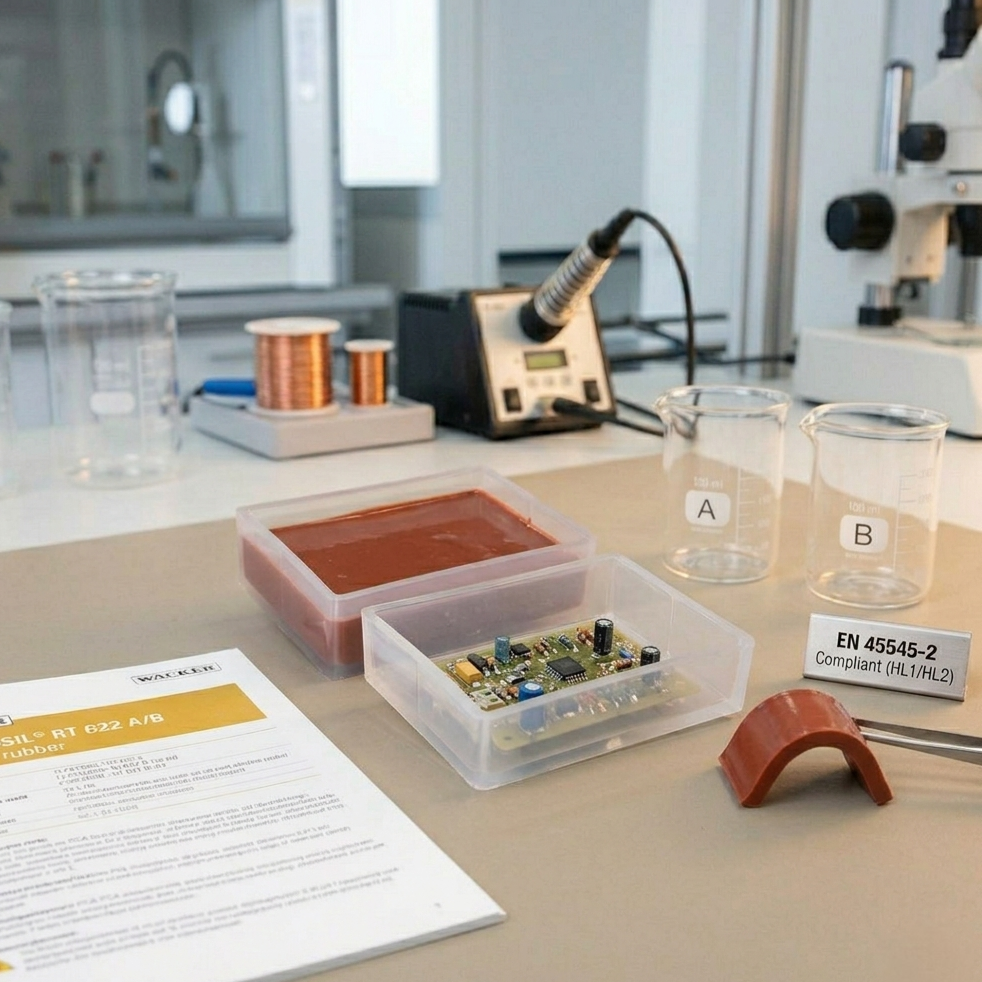
In the world of potting silicones, there are products that simply “perform adequately,” and there are those that set the benchmark for the entire category. ELASTOSIL RT 622 clearly belongs to the latter group. That is precisely why the question of a substitute arises so often—typically in the context of price, availability, or supply chain diversification. The issue is that, in the case of RT622, it is not about a single parameter, but about a very rare combination of properties that competitors usually achieve only partially.
RT622 is a two-component, addition-curing (platinum cure) silicone designed for potting and encapsulation in demanding industrial and electronic applications. Its advantages are already visible at the processing stage—a relatively low viscosity of the A+B system, combined with a controlled pot life, enables stable and repeatable casting processes, even with more complex geometries. However, this alone is not what makes it unique. The real distinction becomes clear when looking at the cured properties: a hardness of around 27 Shore A, very high tear strength (approximately 30 N/mm), elongation at break of about 550%, and virtually negligible shrinkage. It is this combination—softness, flexibility, and mechanical durability—that allows the material to effectively compensate for stress while providing long-term protection of components.
In practice, this means RT622 does not “work against the application.” In electronics potting, it reduces the risk of cracking and delamination during thermal cycling. In coil and energy applications, it effectively dampens stresses resulting from differences in material expansion. In sectors such as railway, it also meets additional regulatory requirements. Many manufacturers offer silicones with similar hardness, but when attempting to achieve the same level of tear resistance, a compromise typically appears—the material becomes either harder or less elastic. Conversely, very soft formulations often sacrifice mechanical strength and long-term durability.
A natural direction when searching for alternatives is to consider products from companies such as Momentive, Dow, Shin-Etsu, or Elkem. Indeed, each of them offers solutions that are formally similar: two-component, addition-curing silicones intended for potting. The problem is that “similar” does not mean “equivalent.” With Momentive products, one often achieves very good mechanical strength, but at the expense of other processing parameters or availability of specific grades. Dow solutions, such as the well-known Sylgard series, are often more optimized for electronics and dielectric stability, yet tend to be significantly harder or exhibit different rheology, which affects processing behavior. Shin-Etsu offers highly flowable systems with good elasticity, but in many cases their tear resistance does not match RT622. Elkem, in turn, provides solid encapsulation products, though they are typically designed more with processing efficiency and cost in mind than maximum mechanical performance.
As a result, when attempting a direct substitution of RT622, one of three scenarios is usually observed. The first is an increase in hardness—the material no longer compensates stress to the same extent as the original. The second is a decrease in mechanical resistance—particularly noticeable under dynamic conditions or vibration. The third is a change in processing behavior, where differences in viscosity and pot life require adjustments to the technology. Each of these scenarios may be acceptable under certain conditions, but all represent a departure from the carefully balanced profile of RT622.
Balance is the key word here. In many engineering projects, the goal is not to maximize a single parameter, but to maintain the stability of the entire system over years of operation. RT622 offers a combination of properties that minimizes operational risks—from microcracking and material fatigue to adhesion issues and material compatibility challenges. Competitors may match individual aspects, but rarely the full spectrum at once.
So, does a true substitute for RT622 exist? The answer specialists expect is: not in a strict sense. There are materials that can fulfill the same function in a specific application, provided that differences are consciously accepted and the process or requirements are properly adjusted. That is why, instead of searching for a simple “1:1” replacement, a much more effective approach is application-driven—analyzing operating conditions, mechanical loads, and regulatory requirements, and only then selecting an alternative.
From an engineering perspective, RT622 remains a benchmark—not because there is no competition, but because competing products still rarely offer such a refined balance of properties. This is why, despite cost pressures and the growing number of available RTV-2 systems, in many applications the decision to stick with RT622 is not driven by habit, but by a rational assessment of risk.
 Log in with Facebook
 Log in with Google